Actuarial Lab · Survival Run
Survival Run Guide - Annuity Pricing
Price a 20-year annuity from a mortality table one hurdle at a time, then absorb a longevity shock that reprices the whole book.
What is mortality/survival probability?
For a person aged x, actuaries define qx as the probability they die within the next year, and px = 1 - qx as the probability they survive it. These rates are estimated from large population studies and organized into mortality tables - one of the oldest and most foundational tools in actuarial science, underpinning the pricing of life insurance, annuities, and pensions alike.
The probability of surviving several years in a row is a product. Surviving k years means clearing each of the k individual one-year hurdles in sequence, so the k-year survival probability is p_x times p_(x+1) times every subsequent year's survival probability, compounding multiplicatively. Because it compounds, even a small change in each year's mortality rate can move a long-horizon survival probability far more than intuition suggests - this is a common source of first-time calculation errors.
Survival probability combines with ordinary time-value discounting to price anything that pays out contingent on someone being alive: a payment due k years from now is worth its face value multiplied by two separate discount factors, one for the time value of money and one for the chance the payment is actually triggered. Pricing a life-contingent product like an annuity means summing this discounted, probability-weighted term over every future date it could pay - the same present-value logic used throughout finance, with a survival probability layered on top of the usual interest discount.
This structure creates a distinct kind of risk called longevity risk. An annuity provider is short longevity - it loses money whenever people live longer than the mortality table it priced against assumed, because it must keep paying for as long as the annuitant survives - while a term life insurer is exposed in roughly the opposite direction. Broad improvements in mortality, driven by medical or public-health progress, are unambiguously good for the population but represent a systemic risk for annuity writers and pension funds specifically, because the effect hits the entire book of business at once, where ordinary mortality risk averages out across independent policyholders.
Mortality tables and the present-value machinery built on them form the foundation of the life-contingencies portion of the actuarial exam sequence, and the same underlying idea - a probability of an event surviving or occurring over time, discounted and summed - reappears well outside insurance, in credit risk (probability of default over time), reliability engineering, and clinical survival analysis.
How it works
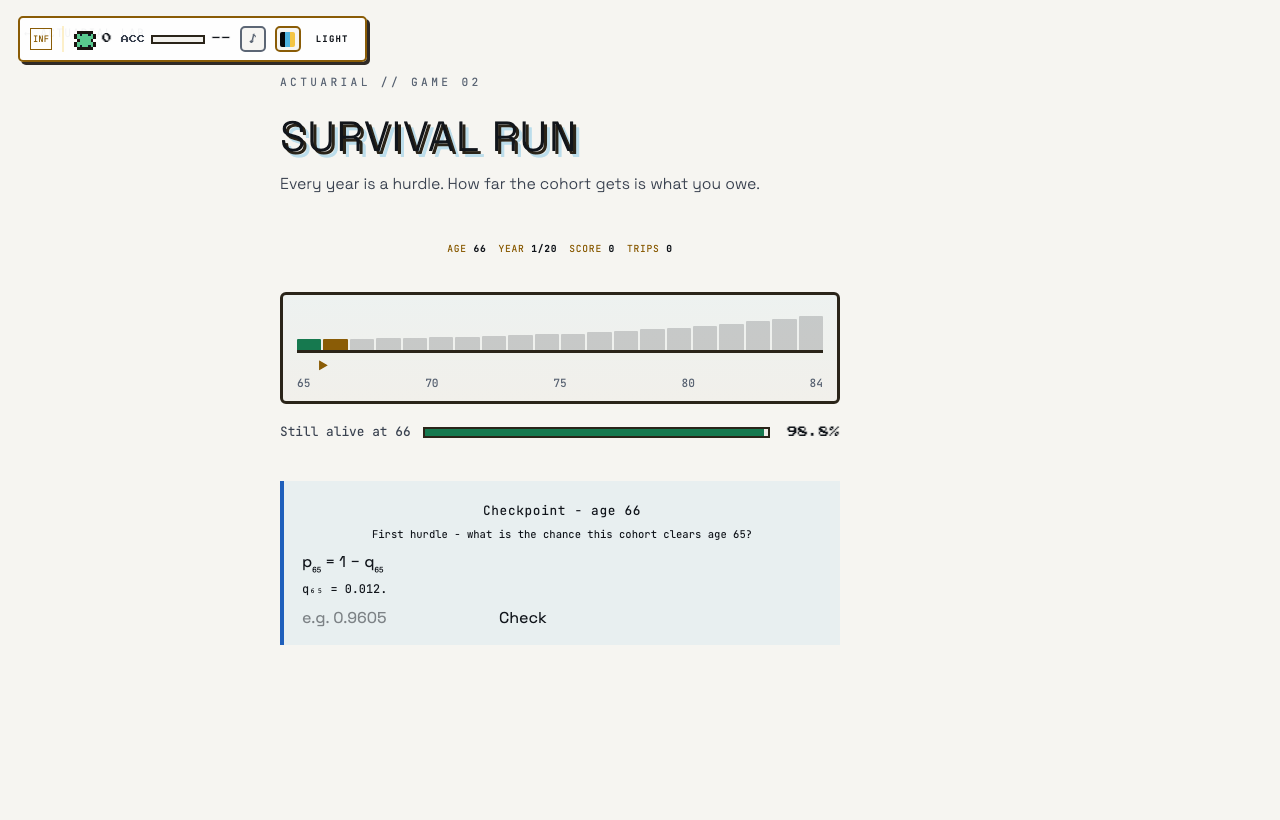
A cohort aged 65 collects $20,000 a year for up to 20 years, and you sold the annuity. The game animates a runner along a track of 20 hurdles - one per year of age from 65 to 84, each hurdle's height set by that year's mortality rate q from the table, which rises from 0.012 at 65 to 0.111 at 84. The distance the runner covers is the survival curve itself, shown as a live percentage.
The run halts at four checkpoints, each a numeric question with its formula and hints displayed: at year 1, the one-year survival probability p65 = 1 - q65; at year 3, the three-year survival, the product of the first three annual survival probabilities; at year 8, the expected present value of that year's payment, v^8 x 8p65 x 20,000 at a 4% annual effective rate; and at the end, the full annuity-due price, the sum over k = 0 to 19 of v^k x kp65 x 20,000. Tolerances widen with the size of the answer (0.0005, 0.0015, 60, and 900 respectively).
After the final checkpoint, news breaks: a new cardiac therapy cuts every q in the table by 25%. You priced the book on the old table, and the final question asks for the shortfall per policy - the improved-table EPV minus the priced EPV - within a tolerance of 900. Wrong checkpoint answers count as trips (tracked in the HUD) but the run continues either way; you can restart and price another cohort at the end.
How scoring works
Each of the four checkpoints pays +2 points for an answer within its tolerance; a miss adds one to the trip counter instead. The longevity-shock question pays +3. Maximum 11 per run.
Every answer locks after one check, and pressing Enter checks the current answer or continues the run once checked.
The survival-probability checkpoints record skill attempts under distributions; the present-value questions and the shock record under expected-value.
Survival compounds multiplicatively
The building blocks are q_x, the probability someone aged x dies within the year, and p_x = 1 - q_x. Surviving k whole years means clearing every hurdle in sequence, so kp_x is a product: p_x x p_(x+1) x ... x p_(x+k-1). Never add - the probabilities chain.
A small change in each annual q moves a long-dated survival probability far more than intuition suggests, because the change is applied 10 or 20 times over. That is why the final longevity shock is expensive.
For hand computation at the early checkpoints, multiply the survival factors directly (0.988 x 0.987 x 0.985) - the tolerances are tight (0.0015 at year 3) and the table's q values are given in the hints.
Two discounts stack: time and mortality
A payment due k years from now is worth v^k x kp_x x amount today, where v^k = 1/(1.04)^k. One discount for the time value of money, one for the chance nobody is alive to collect. Both factors are below 1 and they multiply, which is why late payments in the schedule contribute so little to the price.
The whole annuity is just this term summed. Because it is an annuity-due, payments land at the start of each year: k runs from 0 to 19, and the k = 0 term is exactly 1 x payment - no discount, no mortality, the first payment is certain. Forgetting that certain first payment (or summing k = 1 to 20 as if payments came at year end) is the classic annuity-due versus annuity-immediate error.
For the year-8 checkpoint the game hands you both factors in the hint; the work is disciplined multiplication, keeping six decimals until the final product since the tolerance is 60 on a roughly 12,700 answer.
The annuity writer is short longevity
The shock scales every q by 0.75 - mortality falls 25% across the board. Since the liability is a sum of terms each containing kp_x, and every kp_x rises when every q falls, the EPV of the book can only go up. Reserves set on the old table are now short by the difference, per policy, and the game asks for exactly that: improved EPV minus priced EPV.
Practically, you compute the annuity-due sum twice, once per table, and subtract. The fastest reliable route is a running product for kp_x updated year by year alongside a running discount factor, accumulating the sum as you go - the same loop the game itself runs.
Notice the asymmetry the closing screen states: a 25% mortality improvement moves this 20-year liability by only a few percent, because discounting mutes distant payments and the damage concentrates in years the cohort was always likely to reach. On a whole-life annuity with no 20-year cutoff, the same improvement bites far harder - the payments it adds are the ones never reserved for.
A worked example
Checkpoint 1 (age 65): one-year survival is 1 minus the annual mortality rate. Enter 0.9880.
Checkpoint 2: surviving three whole years means clearing three hurdles in sequence, so kp_x is a product, never a sum.
Multiply stepwise, keeping six decimals. Enter 0.960529.
Checkpoint 3 (year 8): the expected present value stacks two discounts, time value and mortality, both given in the hint.
Substitute and multiply through. Enter about 12,662 (tolerance 60).
Checkpoint 4: the full annuity-due price sums this term from k = 0 to 19 - payments are due at the start of each year, so the k = 0 term is exactly the undiscounted, mortality-free payment.
The longevity shock: rebuild the same sum with every q cut 25%, then subtract the original price. Survival to 84 rises from about 51% to about 60%, and the difference is the shortfall per policy (tolerance 900).
Common mistakes
• Adding survival probabilities or averaging q values. kp_x is a product of one-year survivals; any additive shortcut fails the tight early tolerances.
• Dropping one of the two discounts at year 8. The EPV needs both v^8 and 8p65; using only the interest discount overstates the answer by about 15%.
• Starting the annuity sum at k = 1. Payments are due at the start of each year, so k = 0 to 19 and the first term is an undiscounted, mortality-free 20,000.
• Rounding intermediate survival products to three decimals. Compounded over many years the drift exceeds the tolerances; carry six decimals as the game's own hints do.
• Reasoning that better mortality is good news for the writer. The annuity writer is short longevity - every improvement in mortality raises the liability, and the shock question wants the increase, a positive shortfall.
Why interviews test this
This is core life-contingencies material - the q_x / p_x / kp_x notation, expected present values, and the annuity-due sum are the foundation of the actuarial exam sequence covering life contingencies, and interviewers for life and pensions roles expect them to be automatic. The annuity-due detail (first payment certain, sum starting at k = 0) is a favorite trap because it is a one-index error with a visible price impact.
The longevity shock is the conceptual question that follows: who is short longevity, and what happens to reserves when mortality improves? Being able to say the annuity writer loses, quantify the shortfall as the difference of two EPVs, and explain why a capped-term annuity mutes the effect relative to whole-life, is the kind of answer that shows you can connect table mechanics to balance-sheet risk.
Play Survival Run on Outcry
Survival Run is free to play on Outcry, in the Actuarial Lab section, and every run is timed and scored. Read the guide once, then play Survival Run and check your score against the strategy above. The guide book has a written guide for every other game, and the practice hub and mock assessments put the same skills under a real screen's clock.