Gradient Lab · Taylor Slider
Taylor Slider Guide - Series Approximation by Hand
Sum a Taylor polynomial by hand - order 2, 3, or 4 for eˣ, sin, cos, or ln(1+x) at a given point - and see how fast the error shrinks.
What is a Taylor series?
A Taylor series approximates a function near a point using only its value and derivatives at that point. The idea is to build a polynomial that matches f and as many of its derivatives as possible at x = a: f(x) ≈ f(a) + f'(a)(x-a) + f''(a)(x-a)²/2! + f'''(a)(x-a)³/3! + ..., where the Maclaurin series is just the special case centered at a = 0. Truncating after finitely many terms gives a Taylor polynomial - a computable stand-in for a function that may be hard to evaluate directly.
The intuition is successive refinement. The zeroth-order term alone is a constant approximation; adding the first-order term turns it into the tangent line, which matches the function's value and slope; adding the second-order term bends that line to match curvature as well. Each additional term captures one more derivative's worth of local behavior, and near the center point a, higher powers of (x - a) shrink fast when |x - a| is small, so a handful of terms is usually enough to be accurate close to the center.
How good the approximation is, and how far it stays good, are two different questions. Taylor's theorem bounds the error after truncating at order n by the size of the next term, loosely controlled by the (n+1)-th derivative, which is why the natural way to estimate an approximation's error is to look at the first term you dropped. Separately, a series' radius of convergence limits where summing infinitely many terms even converges to the right answer at all - eˣ, sin(x), and cos(x) converge everywhere, while a series like the one for ln(1+x) only converges for -1 < x ≤ 1, and near the edge of that interval convergence can be very slow even though it technically holds.
Taylor expansion is one of the most reused tools in quantitative finance because so many quantities are naturally treated as small perturbations. The log-return approximation ln(1+x) ≈ x - x²/2 underlies the relationship between arithmetic and geometric returns and the volatility drag on compounded growth. Delta-gamma approximations of option P&L, duration and convexity in fixed income, and Itô's lemma itself are all second-order Taylor expansions - delta or duration is the first-derivative term, gamma or convexity is the second-derivative term, and both exist specifically to make a nonlinear price movement tractable as a local polynomial.
How it works
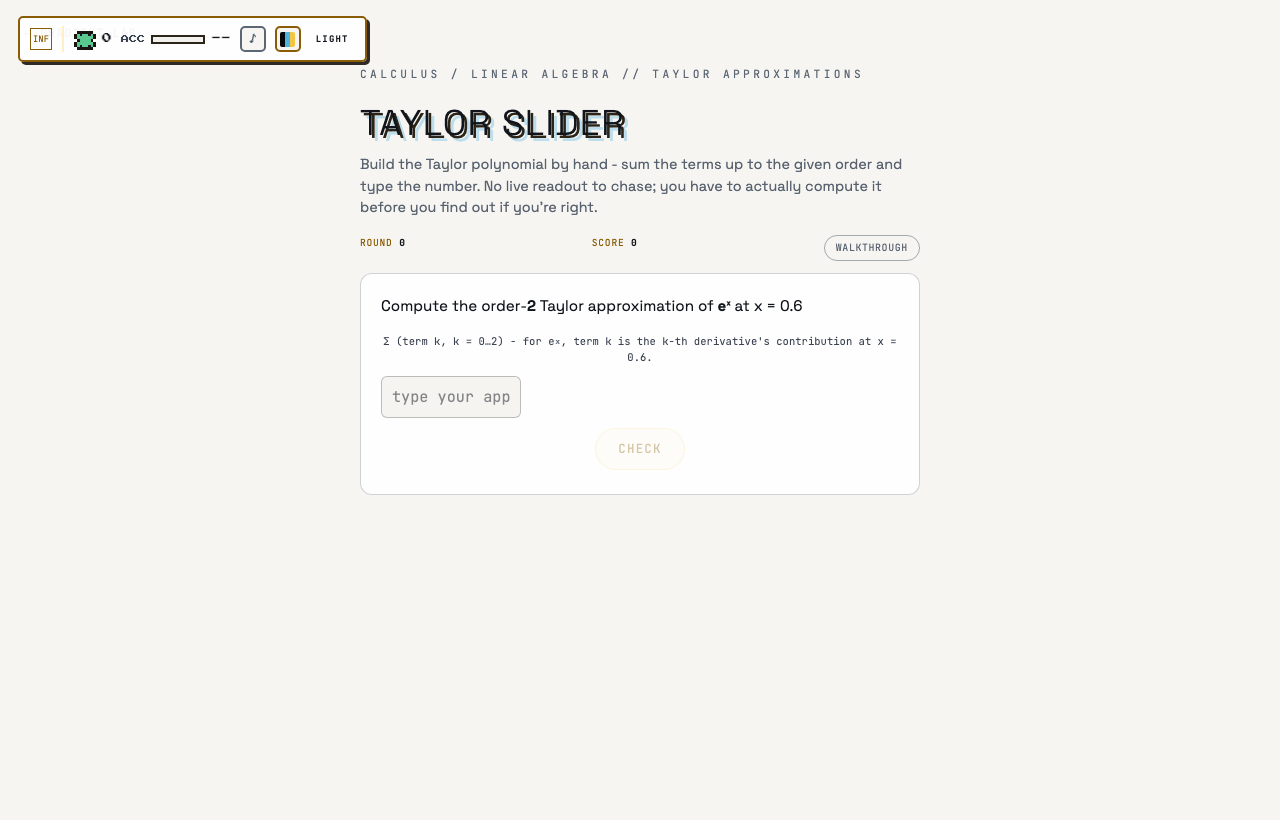
Each round picks one of four functions - eˣ, sin(x), cos(x), or ln(1+x) - a sample point x, and an order from 2, 3, or 4 (kept low enough to sum by hand). You compute the Taylor (Maclaurin, centered at 0) approximation of that order at that x and type the number. There is no live readout - you find out only after committing.
The sample points are chosen per function: for ln(1+x) they all lie inside the series' interval of convergence (-1 < x ≤ 1), such as -0.9, -0.6, -0.4, 0.5, 0.8, 0.95; the other functions use points like -1.8, -1.3, -0.8, 0.6, 1.1, 1.5, 1.9. Each round also carries an error threshold of 0.1, 0.01, or 0.001 used in the reveal.
After checking, the reveal shows the exact order-n sum, the true function value, the resulting error, and whether your assigned order clears the round's error threshold - including the smallest order (up to 8) that does, or a note that even order 8 cannot reach it at that x.
How scoring works
Your answer is graded within a tolerance of max(0.01, 0.5% of the true partial sum). A correct answer adds 1 to score; every check adds 1 to rounds. The threshold comparison in the reveal is informational - only the typed sum is graded.
Know the four series cold
Everything in this game comes from four Maclaurin expansions. eˣ = 1 + x + x²/2 + x³/6 + x⁴/24 + …, every power present. sin(x) = x - x³/6 + x⁵/120 - …, odd powers only, signs alternating. cos(x) = 1 - x²/2 + x⁴/24 - …, even powers only, alternating. ln(1+x) = x - x²/2 + x³/3 - x⁴/4 + …, every power from 1, alternating, with 1/k denominators rather than factorials.
The parity structure matters for what 'order n' contains: an order-4 sin polynomial is just x - x³/6, because the x⁴ term of sine is zero. Likewise order-3 cosine is 1 - x²/2. When the game says order 4, sum every term of degree at most 4 that exists for that function - do not invent even terms for sine or odd terms for cosine.
The two 1/k-versus-1/k! families behave very differently: factorial denominators crush terms fast, so eˣ, sin, and cos converge everywhere and quickly; the harmonic denominators of ln(1+x) shrink slowly, which is why its convergence is confined to -1 < x ≤ 1 and why the game samples it only inside that interval - outside it, adding terms never helps.
Organize the arithmetic term by term
Build a small table: powers of x first, then divide by the right denominator, then apply signs, then add in one pass. Powers chain cheaply - compute x², multiply by x for x³, again for x⁴. At x = 0.6: x² = 0.36, x³ = 0.216, x⁴ = 0.1296. Keep one more decimal than you think you need; the grading tolerance is 0.5% of the sum with a floor of 0.01, so sloppy rounding across four terms can cost the round.
For alternating series (everything here except eˣ, plus ln at positive x and eˣ at negative x behaves similarly), add terms in order and watch the partial sums bracket the answer - each successive partial sum overshoots the truth in alternating directions. That bracketing is a built-in arithmetic check: if your partial sums are not alternating around a shrinking interval, you dropped a sign.
Negative x deserves extra care with odd powers: at x = -0.8, x³ = -0.512, so the ln series term -x²/2 + x³/3 becomes -0.32 - 0.1707, both negative - for negative arguments the ln series terms all push the same (negative) direction and the sum dives, which is why ln(1 - 0.9) needs many terms.
Read the error like Lagrange would
The error of a truncated Taylor series is governed by the first term you dropped: for these series the remainder after order n is roughly the size of the next nonzero term (exactly bounded by it, for alternating series with decreasing terms). So before the reveal you can estimate your own error: order-3 eˣ at x = 1.1 drops x⁴/24 ≈ 0.061 first - so expect an error near 0.06, clearing a 0.1 threshold but not 0.01.
This next-term heuristic explains the reveal's smallest-order line. To clear a threshold ε at a point x, find the first k where the term magnitude drops below ε. Factorial denominators mean each extra order multiplies the term by x/(k+1), so once k exceeds |x| the terms collapse rapidly - for |x| < 2 a few extra orders buy orders of magnitude of accuracy.
For ln(1+x) near the edge of convergence (x = 0.95 or -0.9), terms shrink like xᵏ/k - painfully slowly. That is the deep lesson the game's design encodes: convergence radius and convergence speed are different things, and an approximation that is excellent at x = 0.5 can be nearly useless at x = 0.95 at any hand-computable order.
A worked example
Setup: which terms exist for the order-3 Maclaurin polynomial of eˣ.
Compute the powers of x = 0.6.
Divide and sum the terms in one pass.
Grading tolerance - 1.816 is safely inside it.
Compare against the true value to find the actual error.
The next-term heuristic predicts that error almost exactly, from the first dropped term.
This order clears a 0.01 threshold but not 0.001 - the size of the next term shows order 4 would be needed for that.
Common mistakes
• Including terms that do not exist: sine has no even-power terms and cosine no odd ones. Order 4 for sin(x) means x - x³/6, nothing more.
• Using factorial denominators for ln(1+x). Its series divides by k, not k!: x - x²/2 + x³/3 - x⁴/4. Writing x³/6 there is the single most common slip.
• Dropping a sign on alternating series, especially with negative x where the parity of the power flips signs again. Track sign and power separately.
• Answering the true function value instead of the partial sum. The game grades the order-n sum; at low orders and larger x, the two differ by more than the tolerance and the calculator answer is marked wrong.
• Rounding each term to 2 decimals before summing. Four rounded terms can drift beyond the 0.5% tolerance - carry 4 or 5 decimals through and round once at the end.
Why interviews test this
Taylor expansion is arguably the most-used tool in quant interviews: quick numeric estimates (e^0.1, ln(1.05)), the log-return approximation ln(1+x) ≈ x - x²/2 behind volatility drag, Itô's lemma as a second-order expansion, delta-gamma P&L approximations, and duration-convexity in rates are all order-2 Taylor arguments. Being able to sum to order 3 or 4 by hand, cleanly, is table stakes.
The error question is the differentiator: interviewers follow up with how big is the error and when does the expansion fail. The next-dropped-term estimate and the convergence-interval caveat for ln(1+x) - the exact two facts this game's reveal drills - are the expected answers.
Play Taylor Slider on Outcry
Taylor Slider is free to play on Outcry, in the Gradient Lab section, and every run is timed and scored. Read the guide once, then play Taylor Slider and check your score against the strategy above. The guide book has a written guide for every other game, and the practice hub and mock assessments put the same skills under a real screen's clock.