Drill Lab · Sequence Sprint
Sequence Sprint Strategy - Next Number Patterns
Find the rule and type the next number - freshly generated arithmetic, geometric, square, alternating, and Fibonacci-style sequences.
What is sequence pattern recognition?
Sequence pattern recognition is the ability to infer the rule generating an ordered list of numbers from just a handful of examples, and then extrapolate it forward. It is an act of induction - working from limited evidence to a general rule - and it is separate from calculation: someone can compute quickly and still be slow to spot the rule, or spot the rule instantly and then fumble the arithmetic that applies it.
It is a trainable skill because it improves with exposure to the common families a rule is likely to take. This is close to what psychologists call fluid intelligence - reasoning with novel material - measured by tests like Raven's Progressive Matrices, which likewise ask a person to infer a rule from a small set of examples and apply it. In practice, most sequence tests draw from a limited palette of underlying structures, so practice narrows the search.
The core technique - taking successive differences between terms - is an ordinary mathematical tool, the same first move used to identify whether a numeric pattern is linear, geometric, or something else, and it is the standard way to reduce an unfamiliar sequence to a shape you recognize: constant differences, alternating differences, growing differences, or differences that echo the sequence itself.
Interviewers use next-number sequences because they are fast to administer and cleanly separate two ways of working: candidates who classify systematically, testing a rule against the whole sequence before answering, from those who pattern-match on gut feeling and guess. The same discipline - looking at how a quantity changes before looking at its level - is the first step in fitting any model to real data, which is part of why the habit is considered worth testing on its own.
How it works
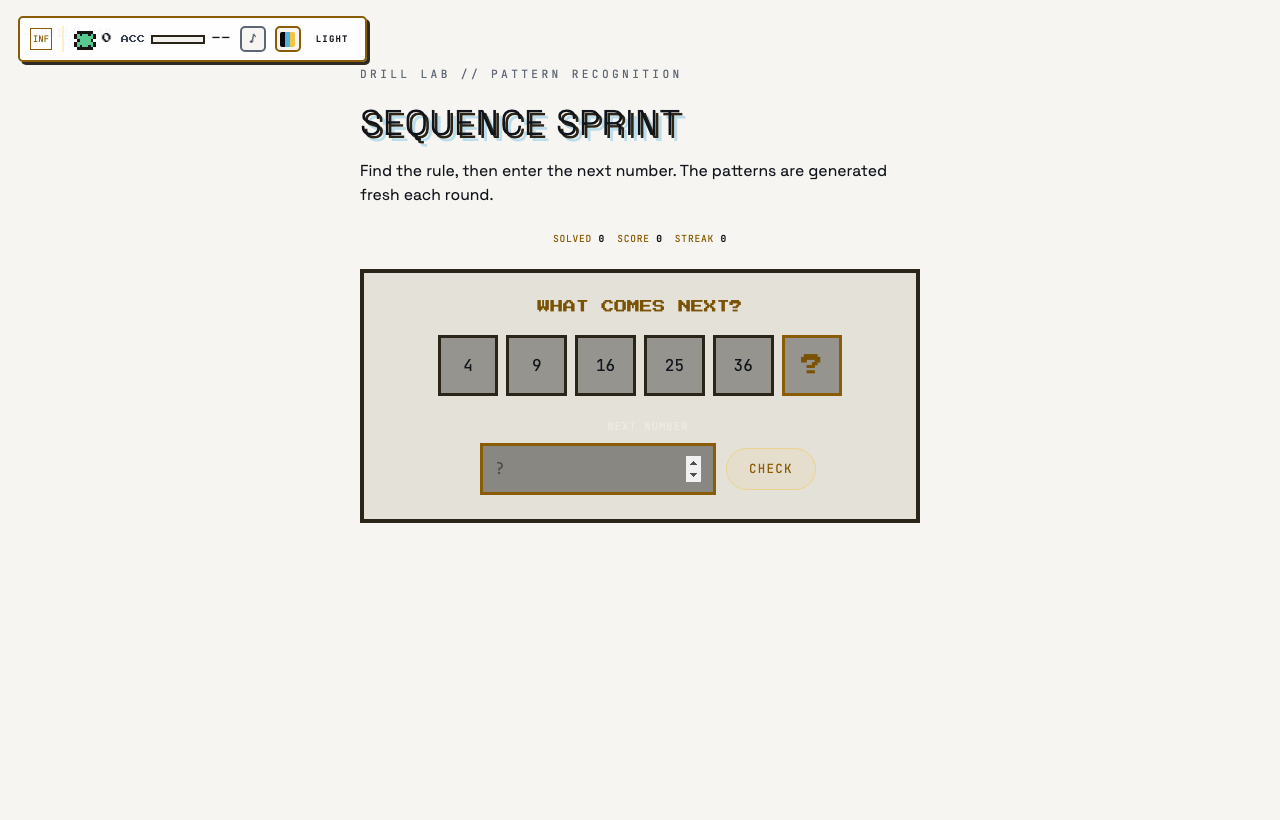
Each round shows a short number sequence with a question mark at the end. Type the next number and press Check; the game reveals whether you were right, shows the correct answer and the rule in plain words, and a Next sequence button deals a fresh round. There is no timer and no round limit - it is an open-ended rep machine.
Every sequence is generated fresh from one of five pattern families: arithmetic (a constant step, which can be negative), geometric (multiply by 2 or 3 each time), consecutive squares, alternating (add one amount, subtract another, repeating), and Fibonacci-style (each term is the sum of the previous two, from two random small seeds).
The HUD tracks three numbers as you play: SOLVED (total rounds attempted), SCORE (correct answers), and STREAK (consecutive correct, reset by a miss).
How scoring works
Scoring is one point per correct answer, exact match only. A correct answer adds 1 to SCORE and extends STREAK; a wrong answer adds nothing and resets STREAK to 0. Every submission increments the SOLVED counter.
There are no tiers, no time limits, and no adaptive difficulty - each round draws uniformly from the five pattern families.
Take first differences before anything else
Almost every sequence in this generator is identified by one pass of first differences. Constant differences: arithmetic, and the constant is the step. Differences that alternate between two values (one positive, one negative): the alternating family. Differences that grow - check whether they are consecutive odd numbers (squares), whether each term is a fixed multiple of the last (geometric), or whether each difference equals the term before it (Fibonacci-style).
This is a decision tree. Compute two or three differences and you have branched to one family; compute the rest only to confirm. Players who stare at the raw terms hunting for meaning are slower than players who difference first, every time.
Know the five families' fingerprints
Arithmetic: five terms, constant step drawn from a small set of values between -9 and +9 (never 0 or 1). Negative steps are in the pool, so a decreasing sequence is normal. Geometric: only four terms shown, ratio always 2 or 3, starting small - so if the terms roughly double or triple, you are done; multiply the last term by the ratio.
Squares: five consecutive perfect squares starting from 1 through 25. Knowing squares through 10^2 by sight (1, 4, 9, 16, 25, 36, 49, 64, 81, 100) makes these instant - the answer is the next square. Alternating: six terms, up by one amount then down by a smaller one; the next move after the shown terms is always the up-step. Fibonacci-style: six terms from two random seeds between 1 and 8 - the seeds vary but the add-the-last-two rule is the same, so verify one interior term and sum the last two.
Because the family list is closed, a sequence that resists your first hypothesis is one of the other four. The fastest recovery from a wrong first guess is to run down the remaining fingerprints in order of ease: squares by sight, geometric by ratio, Fibonacci by the sum test, alternating by the two-value difference pattern.
Protect the streak with a one-beat verification
Grading is exact match, so an arithmetic slip on a correctly identified rule still resets the streak. Before submitting, spend one beat applying the rule backward: does the previous term plus your step give the last shown term? For Fibonacci-style, do the last two shown terms sum to your answer? This check costs a second and catches nearly all careless misses.
Watch the sign on decreasing and alternating sequences - the two families most often confused. A strictly decreasing sequence with constant differences is arithmetic with a negative step; a zigzag is alternating. Misreading one as the other produces answers that are close but exactly wrong, and exact-match grading gives no partial credit.
Use the untimed format deliberately: accuracy first, then speed. Since nothing punishes slowness, build a habit of a perfect streak at a comfortable pace, then compress the pace while holding the streak. That ordering builds the pattern recognition that timed interview tests then draw on.
A worked example
The sequence shown, with the next term to find.
Take first differences - they alternate between two fixed values, the fingerprint of the alternating family.
The last move shown was the +7 rise, so per the up-down pattern the next move is the -5 fall.
Verify backward before submitting: the up-down-up-down-up pattern means the next step must be down, confirming 9.
Common mistakes
• Guessing from the raw terms instead of taking first differences - the differences identify the family in one pass.
• Assuming sequences always increase - arithmetic steps here can be negative, and alternating sequences dip on every other term.
• Confusing alternating with arithmetic and applying the wrong step direction on the final move.
• Skipping the one-beat backward check - exact-match grading turns a small arithmetic slip into a full miss and a dead streak.
• Overthinking a stubborn sequence - the family list is closed at five, so cycle the remaining fingerprints instead of hunting for exotic rules.
Why interviews test this
Next-number sequences appear throughout quantitative aptitude screens and trading-firm assessments because they compress two testable skills into seconds: hypothesis generation (which family?) and verification (does the rule fit every term?). The difference-first method is the same discipline as fitting a model - look at the increments before the levels.
Interview versions escalate to second differences and mixed rules, but the taxonomy habit transfers directly: candidates who classify before calculating are consistently faster and calmer on pattern sections than those who pattern-match by intuition.
Play Sequence Sprint on Outcry
Sequence Sprint is free to play on Outcry, in the Drill Lab section, and every run is timed and scored. Read the guide once, then play Sequence Sprint and check your score against the strategy above. The guide book has a written guide for every other game, and the practice hub and mock assessments put the same skills under a real screen's clock.