Quitters Never Lose · Russian Roulette
Russian Roulette Wheel Guide
A shrinking elimination wheel where every safe spin compounds a 97%-of-fair multiplier and every wrong answer marks another losing number.
What is expected value?
Expected value (EV) is the probability-weighted average outcome of an uncertain event: multiply each possible result by its probability and add them up. It is the single most useful number for pricing a bet, a trade, or any decision under uncertainty, because it tells you what the decision is worth on average if you could repeat it many times - even though any one instance of it can win or lose by a wide margin.
A bet is called fair when its expected value equals its cost, favorable when EV exceeds cost, and unfavorable when EV falls short. The gap between the two, expressed as a fraction of the cost, is the house edge - the standard way any gambling operation, and by extension any market maker, quotes how much value it expects to extract per unit wagered or traded, regardless of how the payout table is dressed up.
Expected value also compounds when a bet is repeated or reinvested. A wager with a fixed negative edge, taken over and over with the winnings rolled forward each time, shrinks its expected value geometrically - a run of -3% EV bets multiplies the starting stake by 0.97 each time, so ten repetitions leave barely three-quarters of the expectation intact, even on a lucky path where the running total looks like it's growing. This is the same compounding logic behind bankroll management and the Kelly criterion in trading: a small per-trial edge or cost, multiplied enough times, dominates the outcome.
Because the expected value of taking one more step is knowable in advance, the rational move at any point is to compare it against a known, certain alternative - stopping now and banking what you have. That comparison is the essence of optimal stopping, a problem that shows up throughout probability and decision theory, from classic search problems to deciding when to close out a position whose expected continuation value has turned negative.
How it works
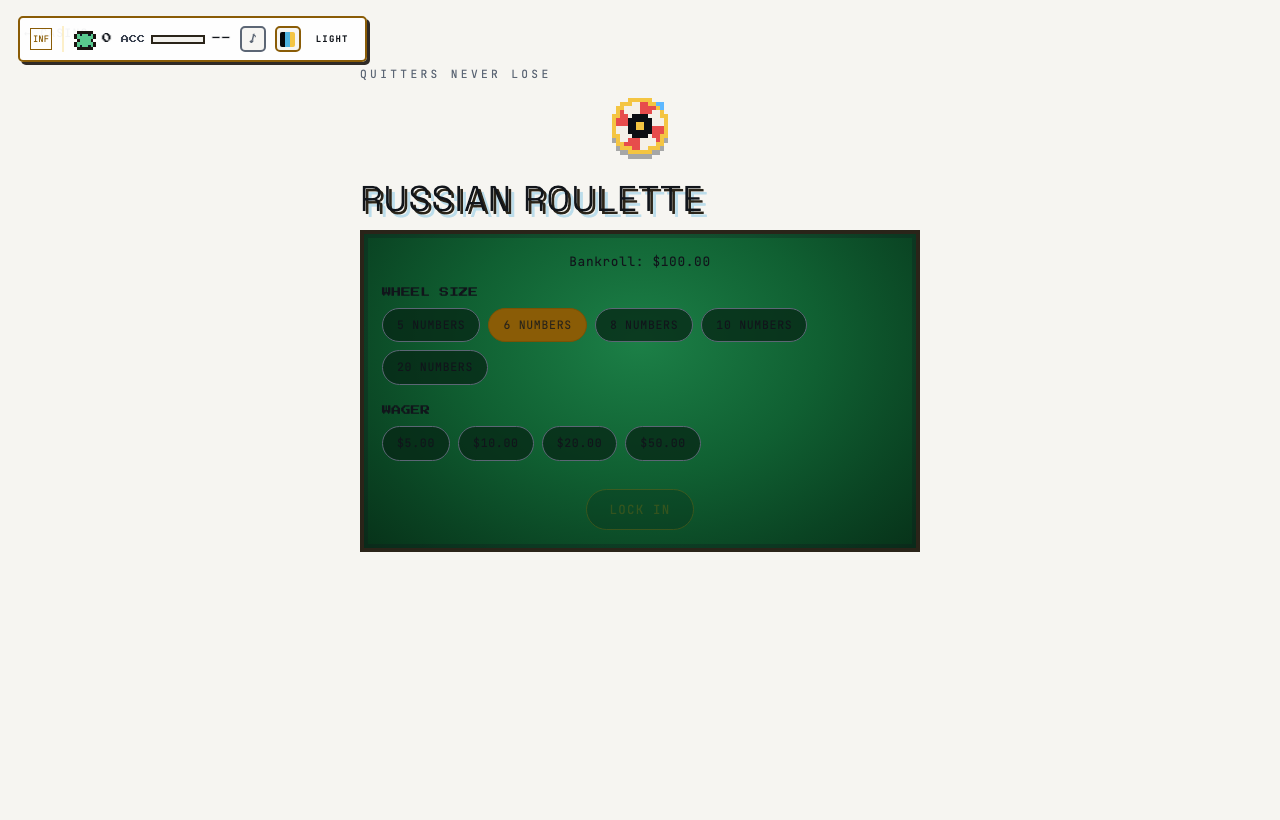
You start with a $100 bankroll, choose a wheel of 5, 6, 8, 10, or 20 numbers, stake $5, $10, $20, or $50, and mark one number as yours. Each spin lands uniformly on one active number. Land on a marked number and you are out - the whole stake is gone. Land on anything else and that number is removed from the wheel for good, your multiplier compounds, and you may spin again or cash out (cashing out is available any time after your first safe spin).
Before every spin you answer a probability question about the current wheel - survival odds over one or several spins, symmetry arguments over your marked numbers, and the like, all computed from the live wheel state. Answer wrong and you must mark an ADDITIONAL number before you are allowed to spin: a wrong answer worsens your odds as well as your score.
The payout mechanism is printed on the wheel: with s safe numbers out of n active, the fair multiplier for a safe spin is n/s (the reciprocal of your survival probability), and the game offers exactly 97% of fair, rounded to 2 decimals. That missing 3% is the house edge, taken on every single spin.
How scoring works
Cash out pays wager x the product of every offered multiplier you have locked in. Each safe spin multiplies in offeredMultiplier = round(0.97 x fairMultiplier, 2 decimals), where fairMultiplier = activeCount / (activeCount - markedCount).
Landing on any marked number pays $0 - the compounded multiplier and the stake vanish together.
Example multipliers from the formula: 8 active, 1 marked: fair 8/7 = 1.1429, offered 1.11. 6 active, 1 marked: fair 6/5 = 1.2, offered 1.16. 6 active, 2 marked: fair 6/4 = 1.5, offered 1.46.
Every spin is a -3% EV trade
Suppose your current cash-out value is V. Taking one more spin returns V x offered with probability s/n and 0 otherwise. Since offered = 0.97 x (n/s), the EV is (s/n) x 0.97 x (n/s) x V = 0.97V. Every spin, on every wheel size, at every stage, converts your position into 97% of itself in expectation.
That makes the whole game a chain: after k spins your expected value is wager x 0.97^k. Ten spins grind expectation down to 0.97^10, about 0.737 of the stake. The compounding multiplier makes the position LOOK like it is growing; the expectation says it is shrinking by 3% per pull. The only +EV button on the screen is Cash Out.
Wrong answers are the real house edge
A wrong answer forces an extra marked number. On a 6-number wheel with 1 marked, your per-spin death probability is 1/6, about 16.7%. Mark a second and it jumps to 2/6, 33.3% - double. The offered multiplier does rise to compensate (6 active, 2 marked offers 1.46 versus 1.16), and the EV identity still holds at 0.97 per spin, but your ruin probability - the chance you lose everything before cashing out - climbs sharply.
The questions themselves are no-replacement drills. The three-spin survival probability on a wheel with s safe of n active is (s/n) x ((s-1)/(n-1)) x ((s-2)/(n-2)) - both numerator and denominator shrink each spin because safe numbers leave the wheel while your marked numbers stay. Reusing the same denominator is the exact error the question is built to catch.
Wheel size only changes variance
A 20-number wheel with 1 marked risks only 1/20 = 5% per spin and offers 0.97 x 20/19, about 1.02x - slow, low-variance decay. A 5-number wheel risks 1/5 = 20% per spin for 0.97 x 5/4 = 1.21x - fast and violent. Both are exactly 0.97 EV per spin. Pick size by how many questions you want to practice per stake, because that is the only thing it changes.
A worked example
Setup: an 8-number wheel, $10 stake, one number marked.
Spin 1: survival probability, the fair multiplier (its reciprocal), and the offered multiplier at 97% of fair.
You survive spin 1, so the position compounds by the offered multiplier and the landed-on number is removed.
Spin 2: with one number removed, 7 are active and 1 is still marked - recompute survival and the offered multiplier from the shrunken wheel.
EV check before taking spin 2: the expected value of spinning again against simply cashing out now.
You spin anyway and survive again - the position compounds once more, and the chance of having survived both spins from the start is the product of both survival fractions.
You cash out. Compare the actual result to the expectation of the two-spin plan computed up front.
Common mistakes
• Reusing the starting denominator on multi-spin survival questions. The wheel shrinks: it is (7/8) x (6/7), not (7/8) x (7/8).
• Reading the compounding multiplier as growing EV. Offered is 97% of fair, so each spin multiplies your expected value by exactly 0.97 no matter what the on-screen number does.
• Guessing on questions. A wrong answer marks an extra number - on a 6-wheel that doubles your per-spin ruin probability from 1/6 to 2/6.
• Choosing a big wheel because it feels safer per spin. 5% per spin at 1.02x and 20% per spin at 1.21x are the same 0.97 EV; only the variance differs.
• Never cashing out. EV after k spins is wager x 0.97^k; ride long enough and either the wheel takes you or the compounding edge does.
Why interviews test this
This is the quant-interview double-or-nothing structure in pure form: a sequence of bets, each individually near-fair but slightly negative, with an option to stop. Interviewers pose it to see whether candidates evaluate the per-step EV (0.97 here) or get drawn along by the running multiplier, and whether they recognize optimal stopping - when every continuation is -EV, the optimal stop is now.
The shrinking wheel is also a clean without-replacement conditional-probability generator, the same math as urn problems and depleting order books: survival probabilities chain as products of changing fractions, and the most common error - frozen denominators - is precisely what phone screens are calibrated to catch.
Play Russian Roulette on Outcry
Russian Roulette is free to play on Outcry, in the Quitters Never Lose section, and every run is timed and scored. Read the guide once, then play Russian Roulette and check your score against the strategy above. The guide book has a written guide for every other game, and the practice hub and mock assessments put the same skills under a real screen's clock.