Quitters Never Lose · Pick 5
Pick 5 Lottery Math Guide
Five digits and a $50,000 Straight at 1 in 100,000 - the biggest jackpot in the lab, at the same 50% house edge.
What is the house edge?
The house edge is the fraction of every dollar wagered that a gambling operator expects to keep over the long run. It is computed as one minus the ratio of a bet's expected value to its price, and it compresses an entire, possibly complicated payout table into a single comparable number: a 10% house edge means the bet returns 90 cents in expectation for every dollar risked, no matter how the prizes themselves are structured.
A fixed-odds game like a numbers lottery makes this especially clean to compute, because the odds are exactly enumerable in advance - there is a finite set of equally likely draws, so the probability of any given ticket winning is known exactly, not estimated. The fair payout for a bet at those odds is simply one divided by its winning probability; a lottery sets its actual payout below that fair figure, and the shortfall is pocketed as the house's margin. Unlike a game with strategic play, no skill or ticket choice changes the odds here - every ticket at a given price carries the identical edge.
Headline jackpot size is a framing effect, because of how expected value is built: probability times payout. A lottery can inflate a jackpot arbitrarily while shrinking its odds by the same factor and land on exactly the same expected value as a much smaller, much more frequent prize. People reliably overweight a rare, vivid, large prize and underweight the tiny probability attached to it - a well-documented pattern in how people perceive probability - which is exactly why bigger, rarer jackpots sell better without being worth any more.
The same exercise - compute the fair value implied by known odds, compare it to the price offered, and name the gap - is how any priced instrument with quantifiable odds gets evaluated, from an insurance premium to a market maker's quoted spread. Asking 'what edge is baked into this price' is a generally useful habit that extends far past lottery tickets.
How it works
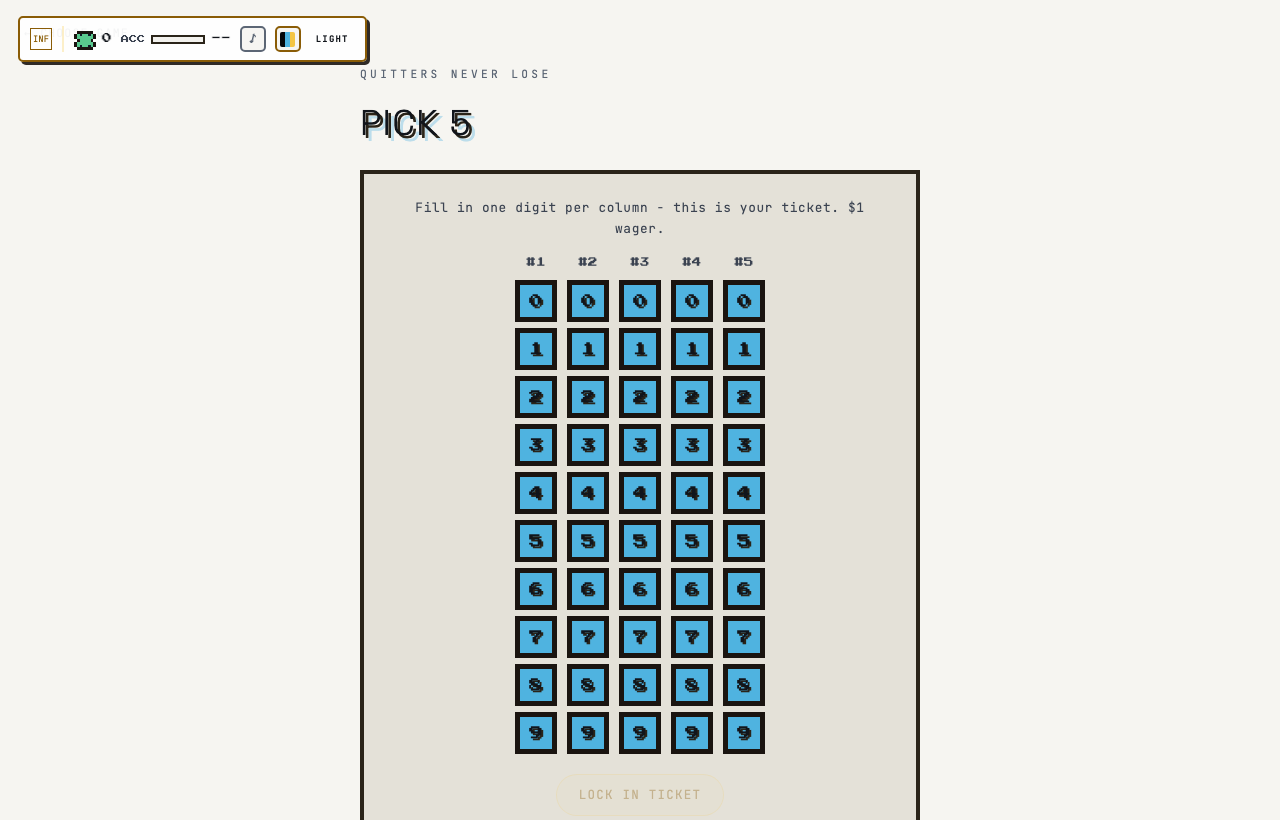
You fill in a 5-digit ticket, one digit (0-9) per column, on a $1 wager, then answer questions generated from your own ticket before the draw - the ordering count, the implied Box payout, the Straight and Box probabilities, and the house-edge computation. The payout model was verified against a real state Pick 5 prize table.
Five digits are drawn uniformly at random and checked against every play type at once: Straight (exact order, 1 in 100,000), Box (same digits any order), Pair (first two digits in order, 1 in 100), and Front 4 / Back 4 - your first or last four digits in exact order at 1 in 10,000 each.
Ways = 5! divided by repeat factorials: five distinct digits are a 120-way; a single pair is a 60-way (5!/2!); a triple is a 20-way; and so on down to 1-way for five of a kind.
How scoring works
Straight pays $50,000 (10^5 / 2) at probability 1/100,000.
Box pays $50,000 / ways - $416.67 on a 120-way, $833.33 on a 60-way - at probability ways/100,000.
Pair pays $50 at probability 1/100. Front 4 and Back 4 each pay $5,000 (10^4 / 2) at probability 1/10,000.
Each payout is exactly half the fair payout for its odds, so EV per $1 is $0.50 on every play type - a uniform 50% house edge.
The jackpot scales; the edge does not
Straight EV: (1/100,000) x $50,000 = $0.50. Box on a 120-way: (120/100,000) x $416.67 = $0.50. Pair: (1/100) x $50 = $0.50. Front 4: (1/10,000) x $5,000 = $0.50. From Pick 3's $500 to Pick 5's $50,000 the jackpot grew 100x while its probability shrank 100x - the EV never moved off 50 cents.
This is the lab's cleanest demonstration that jackpot size is marketing. A fair Straight would pay $100,000; the game, like real lotteries, pays half.
Big factorials, same recipe
Ways = 5!/repeats: 1-2-3-4-5 gives 120; 1-1-2-3-4 gives 5!/2! = 60; 1-1-2-2-3 gives 5!/(2!2!) = 30; 1-1-1-2-3 gives 5!/3! = 20. Box probability is ways/100,000 and Box payout is $50,000/ways, so the two questions answer each other: once you have the way count, both numbers are one division away.
A 120-way Box at 120/100,000 = 0.12% is the most winnable non-Pair bet on the ticket, and it still returns 50 cents per dollar in expectation.
Front/Back 4 nests the whole family
A Front 4 bet is a Pick 4 Straight living inside your Pick 5 ticket: 1/10,000 for $5,000. Pick 5 therefore contains Pick 4's headline bet (Front/Back 4), the Pair from Pick 3, and its own Straight - a nested family of bets whose EV table is a constant. When one row of the table looks tempting, recompute it: (probability) x (payout) = $0.50, always.
A worked example
Setup: ticket 1-2-3-4-5 has five distinct digits, so its orderings are the full factorial.
The way count fixes the Box payout and the Box/Straight probabilities out of 100,000 possible draws.
EV of Straight and Box both land on the same 50 cents on the dollar, despite the huge gap in jackpot size and odds.
EV of Pair and Front 4 confirm the same flat edge across the whole ticket.
The draw comes 5-4-3-2-1: wrong order for Straight, Pair, Front 4, and Back 4, but the same multiset as your ticket, so Box hits and pays out.
Common mistakes
• Chasing the $50,000 headline. At 1/100,000 it prices to the same $0.50 EV as every other bet in the lab's three lotteries.
• Forgetting repeat adjustments at n = 5: 1-1-2-2-3 is 30-way (5!/(2!2!)), not 60 or 120.
• Confusing Box with Front/Back. Box is any order over all five digits; Front 4 and Back 4 are strict in-order positional matches of four.
• Thinking distinct digits are 'smarter' picks. A 120-way ticket wins Box more often and pays proportionally less - EV is identical to a 1-way quint ticket.
• Comparing lotteries by jackpot. Pick 3, 4, and 5 differ only in variance; the house edge is a flat 50% across all of them.
Why interviews test this
Pick 5 completes the scaling argument interviewers often walk candidates through: as n grows, payoff and improbability scale together and expected value is invariant. Recognizing an invariant across a family of bets is the abstraction step that separates a good interview answer from a merely correct one.
It is also a lesson in variance preference: all three Pick games are 50%-edge bets, so choosing among them is purely a choice of payoff distribution. Interviewers use setups like this to ask utility and risk questions, such as why anyone buys the highest-variance version of a strictly losing bet.
Play Pick 5 on Outcry
Pick 5 is free to play on Outcry, in the Quitters Never Lose section, and every run is timed and scored. Read the guide once, then play Pick 5 and check your score against the strategy above. The guide book has a written guide for every other game, and the practice hub and mock assessments put the same skills under a real screen's clock.