Quitters Never Lose · Pick 4
Pick 4 Lottery Math Guide
Four digits, a $5,000 Straight, Front/Back 3 bets - and the same exact 50% house edge on every play type.
What is the house edge?
The house edge is the fraction of every dollar wagered that a gambling operator expects to keep over the long run. It is computed as one minus the ratio of a bet's expected value to its price, and it compresses an entire, possibly complicated payout table into a single comparable number: a 10% house edge means the bet returns 90 cents in expectation for every dollar risked, no matter how the prizes themselves are structured.
A fixed-odds game like a numbers lottery makes this especially clean to compute, because the odds are exactly enumerable in advance - there is a finite set of equally likely draws, so the probability of any given ticket winning is known exactly, not estimated. The fair payout for a bet at those odds is simply one divided by its winning probability; a lottery sets its actual payout below that fair figure, and the shortfall is pocketed as the house's margin. Unlike a game with strategic play, no skill or ticket choice changes the odds here - every ticket at a given price carries the identical edge.
Headline jackpot size is a framing effect, because of how expected value is built: probability times payout. A lottery can inflate a jackpot arbitrarily while shrinking its odds by the same factor and land on exactly the same expected value as a much smaller, much more frequent prize. People reliably overweight a rare, vivid, large prize and underweight the tiny probability attached to it - a well-documented pattern in how people perceive probability - which is exactly why bigger, rarer jackpots sell better without being worth any more.
The same exercise - compute the fair value implied by known odds, compare it to the price offered, and name the gap - is how any priced instrument with quantifiable odds gets evaluated, from an insurance premium to a market maker's quoted spread. Asking 'what edge is baked into this price' is a generally useful habit that extends far past lottery tickets.
How it works
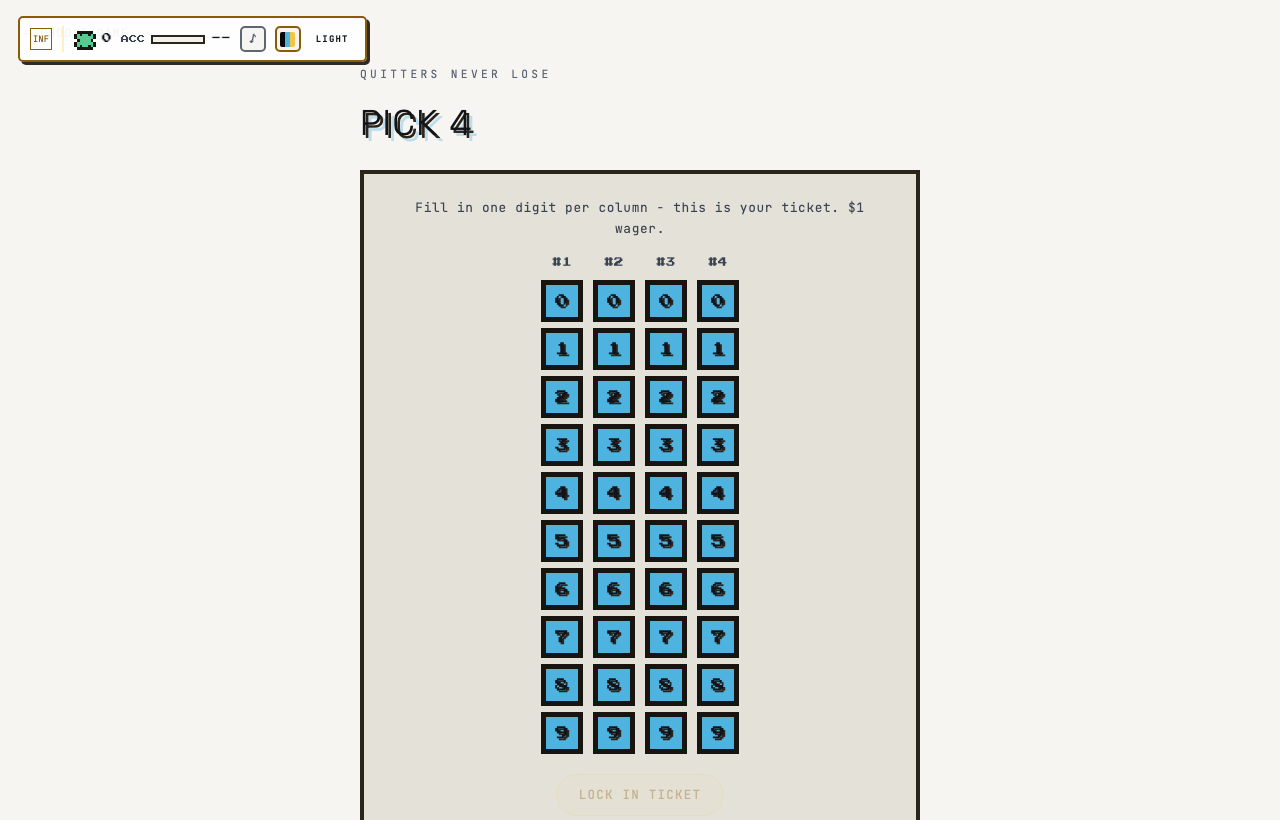
You fill in a 4-digit ticket, one digit (0-9) per column, on a $1 wager. Before the draw you answer questions generated from your own ticket - orderings, the implied Box payout, Straight and Box probabilities, and the house-edge computation.
Four digits are drawn uniformly at random and checked against every play type at once: Straight (exact order, 1 in 10,000), Box (same digits any order, ways in 10,000), Pair (first two digits in order, 1 in 100), and - new at 4 digits - Front 3 and Back 3, which match your first or last three digits in exact order at 1 in 1,000 each.
Ways = 4! divided by repeat factorials: 4 distinct digits are a 24-way, one pair is a 12-way (4!/2! = 12), two pairs are a 6-way, a triple is a 4-way, and quads are 1-way.
How scoring works
Straight pays $5,000 (10^4 / 2) at probability 1/10,000.
Box pays $5,000 / ways - $208.33 on a 24-way, $416.67 on a 12-way - at probability ways/10,000.
Pair pays $50 at probability 1/100. Front 3 and Back 3 each pay $500 (10^3 / 2) at probability 1/1,000.
Every payout is half of fair for its odds: EV per $1 is $0.50 across the board - a uniform 50% house edge.
Run the EV table - it is flat at $0.50
Straight: (1/10,000) x $5,000 = $0.50. Box, 24-way: (24/10,000) x $208.33 = $0.50. Box, 12-way: (12/10,000) x $416.67 = $0.50. Pair: (1/100) x $50 = $0.50. Front 3 or Back 3: (1/1,000) x $500 = $0.50. Fair payouts would be exactly double each of these - $10,000, $416.67, $833.33, $100, $1,000.
The jump from Pick 3 to Pick 4 multiplies the Straight jackpot by 10 and divides its probability by 10. The product - the only thing EV cares about - does not move.
Master the repeat-adjusted way count
Ways = 4! / product of repeat factorials. 1-2-3-4: 24. 1-1-2-3: 4!/2! = 12. 1-1-2-2: 4!/(2!2!) = 6. 1-1-1-2: 4!/3! = 4. 1-1-1-1: 1. The Box question set hinges on producing this number quickly, then reading Box probability as ways/10,000 and Box payout as $5,000/ways.
Notice the see-saw: more ways means a higher hit probability and a proportionally smaller payout. The product is pinned at $0.50 by construction - which is the final question's answer.
Front/Back 3 is Pick 3 hiding inside Pick 4
A Front 3 bet on a 4-digit ticket is exactly a Pick 3 Straight on your first three digits: 1/1,000 for $500. Same for Back 3 on the last three. If you feel tempted by them as 'easier' wins, note they are the identical half-of-fair pricing - a shorter route to the same 50% edge.
A worked example
Setup: ticket 1-1-2-3 repeats the digit 1 twice, so divide out that repeat's factorial to count orderings.
The way count fixes the Box payout and the Box/Straight probabilities out of 10,000 possible draws.
EV of Straight and Box both come out to the same 50 cents on the dollar.
EV of Pair and Front 3 hold the same 50-cent value, confirming the flat edge across every play type on the ticket.
The draw comes 1-3-1-2: wrong order for Straight, Pair, and Front 3, but the same multiset as your ticket, so Box hits and pays out.
Common mistakes
• Treating the $5,000 jackpot as evidence Pick 4 beats Pick 3. Ten times the payout at a tenth the probability is the same $0.50 EV.
• Miscounting ways on double pairs: 1-1-2-2 is 4!/(2!2!) = 6, not 12.
• Reading Front 3 as needing any 3 matching digits. It is the FIRST three digits in exact order - a strict positional match.
• Assuming a Box hit excludes other wins. One draw is checked against every play type; a Straight also pays Pair and both Front/Back 3 when the digits line up.
• Hunting for the play type with the best odds. The last question in the set exists to make you prove there is not one: every option prices at 1 - EV = 50%.
Why interviews test this
Pick 4 is where interviewers escalate the counting: permutations of multisets (the 12-way, 6-way, 4-way cases) are a staple combinatorics screen, and the follow-up 'so which bet is best?' tests whether the candidate has internalized that probability times payout, not either factor alone, is the object of interest.
The invariant - every bet priced at exactly half of fair - is also a miniature of how real derivative pricing questions work: given odds, compute the fair value, compare to the offered price, and state the edge. Here the edge is minus 50% everywhere, and the only winning move is the lab's title.
Play Pick 4 on Outcry
Pick 4 is free to play on Outcry, in the Quitters Never Lose section, and every run is timed and scored. Read the guide once, then play Pick 4 and check your score against the strategy above. The guide book has a written guide for every other game, and the practice hub and mock assessments put the same skills under a real screen's clock.