Drill Lab · Fermi Estimation (Classic)
Fermi Estimation Strategy - Range Quoting
Quote a low-high range on ten real-world estimation questions - points for containing the truth, more points for a tight range.
What is a Fermi estimate?
A Fermi estimate is a rough but structured guess at a quantity you cannot look up or measure directly, arrived at by breaking it into smaller pieces you can each estimate with reasonable confidence and combining them, usually by multiplying. The goal is getting within a defensible range, using reasoning that someone else could check step by step.
The technique is named for the physicist Enrico Fermi, who was known for producing surprisingly good rough estimates from almost no data - most famously estimating the yield of the first nuclear test by watching how far scraps of paper were thrown by the blast wave. The tradition is usually taught through problems like "how many piano tuners are there in Chicago": no one memorizes that number, but you can reason your way to a defensible one from the city's population, how many households own a piano, how often a piano needs tuning, and how many instruments one tuner can service in a year - without looking anything up.
It is a distinct skill because it separates two things that get conflated in ordinary quizzing: knowing facts, and reasoning well from partial facts. Someone can be a strong Fermi estimator without knowing any of the numbers involved precisely, because the skill lives in the decomposition - picking the right factors to multiply - and in judging how much confidence each piece of the chain deserves.
Quant and consulting interviews use estimation questions because they expose exactly that reasoning process in a way a memorized fact cannot. An interviewer watching someone decompose an unfamiliar quantity learns far more about how that person thinks under uncertainty than a right-or-wrong answer would reveal, and the skill maps directly onto real work where the true number - a market size, a trade's expected volume - is never available in advance and a defensible estimate has to be produced anyway.
The discipline that makes it work is thinking in orders of magnitude. For an unknown quantity, landing within a factor of two or three is a success, and being off by a factor of ten is a failure - a different standard from ordinary arithmetic, where the answer is either right or wrong.
How it works
Classic mode deals a 10 question round drawn from a hand-written question bank plus a batch of 30 procedurally generated questions that is refreshed every time you return to the menu. You can filter the pool by category (everyday, physics, geography, economics, biology, engineering, tech, pop culture) and by difficulty (Warm-up, Interview, Hard) before starting.
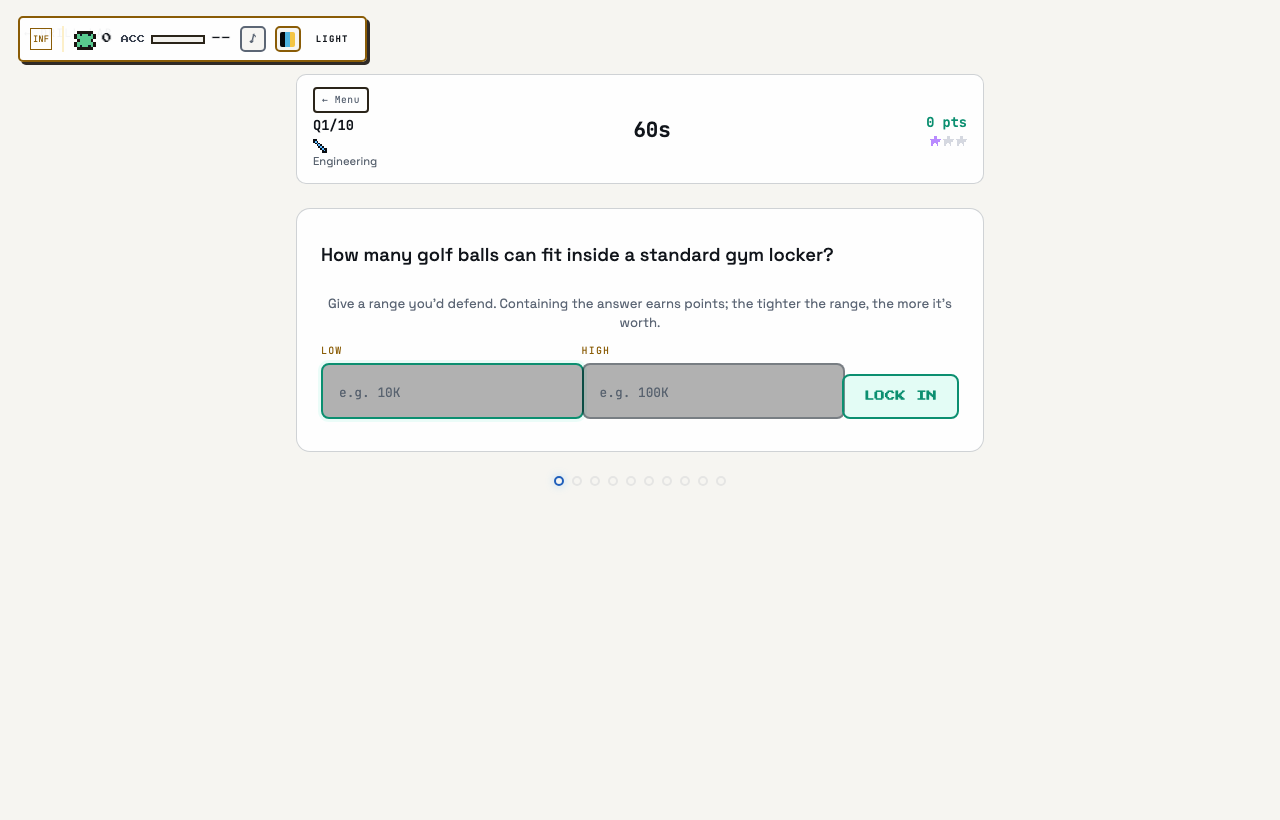
Each question asks for a real-world quantity - platform activity, volumes, populations, physical scales. Instead of a single number you enter two: a LOW and a HIGH bound. You have 60 seconds per question; typing the bounds and submitting is the whole interaction, then the truth and a worked explanation are revealed before the next question.
A bare number hides whether you had any idea; a range you are willing to be held to shows it, and the scoring makes the tension explicit - the range must contain the truth, and the tighter it is, the more it is worth.
How scoring works
Width is measured in orders of magnitude: log10(high) - log10(low). If the truth falls inside your range, you score 4 points for width up to 0.5 orders of magnitude, 3 points up to 1, 2 points up to 2, and 1 point for anything wider - contained but too wide to be useful.
If the truth falls outside your range you score 0, whether you just missed or were wildly off - the feedback distinguishes the two, the points do not. An invalid range (non-positive bounds, or high below low) also scores 0.
Your best round total is stored locally and shown on the menu.
Anchor the order of magnitude first
Before any arithmetic, place the answer on the powers-of-ten ladder. Is this a thousands question, a millions question, a billions question? A handful of memorized anchors covers most of the pool: world population about 8 billion, US population about 330 million, a big city in the single-digit millions, a year is about 3 x 10^7 seconds, a paper bill about 0.1 mm thick. Getting the exponent right is worth more than any precision in the mantissa - the scoring is entirely in log space.
Once the exponent is anchored, the mantissa only needs one significant figure. The difference between 3 x 10^9 and 5 x 10^9 is 0.2 orders of magnitude - inside the top scoring band. The difference between 10^9 and 10^10 is a full band drop. Spend your 60 seconds on the exponent.
Decompose into factors you know
A Fermi question factors into pieces with known anchors: a population, a per-person rate, a timeframe, a unit conversion. "Messages sent on a platform per week" is users x messages per user per day x 7. Write the chain, put one-significant-figure numbers on each factor, and multiply the exponents mentally - add powers of ten, then multiply the leading digits.
Decomposition also tells you how wide to quote. If your chain has three factors and you trust each to within a factor of 2, the product is uncertain by roughly a factor of 8 - just under one order of magnitude, so quote a range about that wide centered on your estimate. A single-factor question you know cold deserves a half-order range and the 4 point band.
Errors in a factor chain partially cancel - some factors you overestimate, some you underestimate. This is why decomposed estimates beat gut numbers: the log-space errors of independent factors average out.
Size the range to the scoring bands
The bands are at 0.5, 1, and 2 orders of magnitude. A half-order range means high is about 3 times low (10^0.5 is roughly 3.16); a one-order range means high = 10 x low. So the practical widths are: confident answer, quote low to 3x low; normal answer, quote low to 10x low; unsure, quote two orders and take the 2 points.
Center your range in log space. If your point estimate is 4 x 10^7 and you want one order of width, quote about 1.3 x 10^7 to 1.3 x 10^8 - a factor of 3 on each side. Linear-symmetric ranges around a big number are secretly lopsided on the log scale where you are being graded.
Never quote an unbounded hedge. A range from 1 to 10^12 always contains the truth and scores just 1 point; two of those cost more than one miss next to two tight hits. The scoring is built to make the hedge a losing strategy.
A worked example
Decompose the quantity into a bill count, using the given net worth and bill denomination.
Anchor the other factor: a bill is about 0.1 mm thick.
Multiply bill count by thickness for the total stack height.
Both factors are solid anchors, so the range can be quoted tight - about a factor of 3 wide.
Check the width in orders of magnitude: under 0.5 puts it in the top scoring band, and the range contains the true 1.1 km.
Common mistakes
• Quoting a single-number-in-disguise range (low 40,000, high 42,000) on a question you have not decomposed - a tight miss scores exactly 0.
• Quoting the 1-to-a-trillion hedge - it always contains the truth and always scores just 1 point.
• Centering the range symmetrically in linear space around a large estimate, which makes it lopsided on the log scale where width is measured.
• Spending the 60 seconds refining the leading digit instead of checking the exponent - one wrong power of ten costs more than any mantissa precision recovers.
• Forgetting unit conversions in the factor chain - days to years and millimeters to kilometers are where clean decompositions silently lose three orders of magnitude.
Why interviews test this
Estimation questions are a staple of quant and consulting interviews because they expose how a candidate reasons with incomplete information: decomposition, sensible anchors, and a width that matches their uncertainty. Interviewers generally care about the structure of the estimate far more than the final number.
The range format matches how trading firms probe this: an interviewer will often ask for a market - a bid and an offer - on an uncertain quantity, then tighten it. Quoting wide when unsure and tight when confident, and knowing which is which, is the skill being tested.
Play Fermi Estimation (Classic) on Outcry
Fermi Estimation (Classic) is free to play on Outcry, in the Drill Lab section, and every run is timed and scored. Read the guide once, then play Fermi Estimation (Classic) and check your score against the strategy above. The guide book has a written guide for every other game, and the practice hub and mock assessments put the same skills under a real screen's clock.