Drill Lab · Crossroad Multitasker
Crossroad Multitasker Strategy - Task Switching
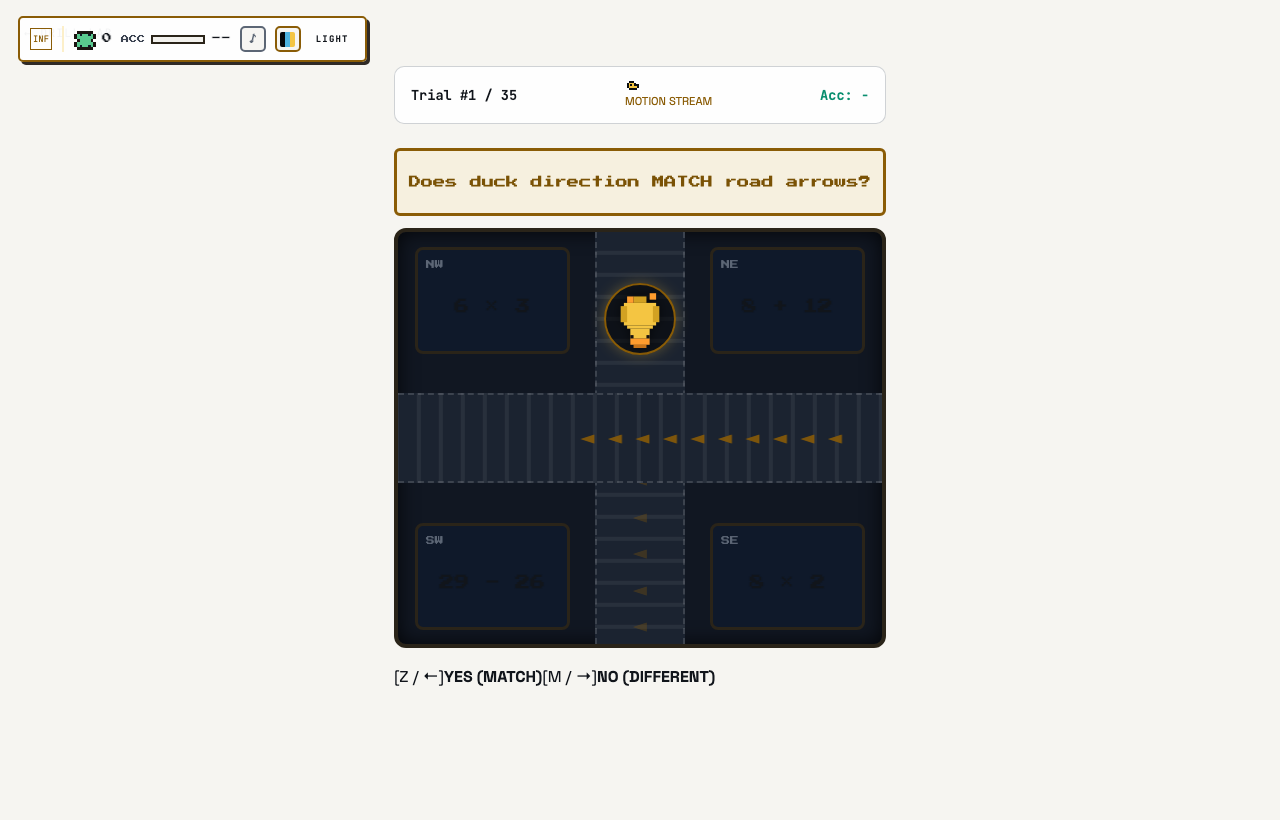
A duck at a 4-way crossroad and four corner math pods - answer whichever question is live as it switches unpredictably between the two streams.
What is cognitive task-switching?
Task-switching is the cognitive act of shifting attention and rule set from one task to another. It is a specific, well-studied topic in cognitive psychology, distinct from how well someone performs either task in isolation.
The standard way it is measured is switch cost: the extra reaction time, and often the extra errors, on a trial that changes tasks compared to a trial that repeats the previous one. The cost exists because disengaging from one task's rule set and engaging the next one's takes measurable time - the mind does not switch instantly even when both tasks are individually simple.
Task-switching ability sits under what psychologists call executive function or cognitive control, and it is treated as distinct from raw processing speed on any single task, because two people equally fast at each task alone can differ sharply in how much a switch costs them. Making the switching pattern unpredictable is what forces that cost to show up - a fixed alternation lets a person prepare in advance and partly erase the cost before it happens.
Desk work is rarely one task at a time - it means monitoring several things at once, fielding interruptions, and responding to whichever demand is live. Trading firms build switching tasks into assessment batteries to see whether a candidate's speed and accuracy hold up when the target of attention keeps moving.
How it works
Two things are always on screen: a duck facing one of four cardinal directions on roads painted with flow arrows, and four corner math pods (simple multiplication, addition, or subtraction), one of which is highlighted as live. Each trial asks one of two questions - motion congruence ("does the duck's facing match the road arrows?") or quadrant math ("is the live corner's result even?") - and you answer YES or NO.
Which stream is asked switches unpredictably from trial to trial, including sometimes staying on the same stream, with a run capped at 3 in a row - so you can never settle into one task or anticipate the switch. A run is 35 trials, and the trial ends the moment you respond; your reaction time is measured from trial start.
Controls: Z or the left arrow answers YES, M or the right arrow answers NO, and there are on-screen buttons labelled to match the live question (YES MATCH / NO DIFFERENT for duck trials, YES EVEN / NO ODD for math trials).
How scoring works
A correct answer scores 100 minus your reaction time in milliseconds divided by 15, with a floor of 10 - so a 300 ms response earns 80 points, a 900 ms response 40, and anything slower than about 1.35 seconds the floor of 10. A wrong answer subtracts 40, and the running total never drops below 0.
The results screen also reports accuracy, average reaction time, and your switch cost: the average reaction time on correct switch trials minus correct repeat trials - a direct measure of how much changing tasks slows you. Your best score is stored locally.
Read the question first, always
The trap in this game is answering the stream you expect instead of the stream being asked. Because the same stimulus is always fully visible - duck and math pods together - your eyes will happily solve the wrong task. Build a rigid order: read which question is live, then look at the relevant stimulus, then answer. The half-second that ordering costs is far cheaper than a -40 for a fast answer to the wrong question.
The cap of 3 repeats in a row is worth internalizing: after three trials on one stream, the next trial is guaranteed to switch. That is the one free prediction the design allows - use it to pre-orient to the other stimulus on the fourth trial, and assume nothing on the rest.
Precompute the cheap stream during dead time
Both judgments can be made from the standing display before the question arrives. The duck check is a single visual comparison - facing versus arrows - that takes a fraction of a second. The live corner's parity is a small computation with shortcuts: for addition and subtraction, only the parity of the operands matters (even plus even and odd plus odd are even; mixed is odd), and a product is even unless both factors are odd. You never need the result, only its parity.
So the strong loop is: the instant a trial resolves, refresh both reads - glance at the duck match, take the parity of the highlighted corner - and hold both one-bit answers in mind. When the next question lands, you are retrieving a prepared bit. This converts a dual-task game into a lookup game and is where sub-500 ms correct responses come from.
Parity shortcuts deserve drilling on their own: "7 x 6, even" (one even factor), "13 + 9, even" (odd plus odd), "21 - 8, odd" (mixed). Saying the parity without computing 42, 22, or 13 is the whole trick - the operands' last digits tell you everything.
Manage switch cost like the metric it is
The game measures your switch cost explicitly, and the score formula makes its price concrete: every extra 150 ms of reaction time costs 10 points on a correct answer. The classic result in task-switching research is that switch trials are slower because the old task set lingers; the countermeasure is to drop the old set deliberately - after answering, do not linger on the stream you just answered. Return to neutral, refresh both reads.
Respect the asymmetry between the streams. The duck judgment is nearly free; the math judgment has real content. So when you must triage under pressure, keep the math parity fresh and let the duck read happen on demand - a stale duck read costs a quarter second to redo, a stale math read costs a full computation.
The -40 penalty against a 10-to-100 point gain sets the speed-accuracy dial: a wrong answer erases roughly half a fast correct answer plus the trial itself. Across 35 trials, 90-plus percent accuracy at a moderate pace outscores blazing speed at 80 percent. Push speed only on trials where your prepared bit is fresh and certain.
A worked example
During dead time, refresh the duck read: facing versus road arrows.
Also refresh the math read: only the live corner's parity matters, not its value.
The live question turns out to be motion congruence - read the question, then retrieve the matching prepared bit, not the other one.
Score the correct, fast response with the game's formula: 100 minus reaction time in ms divided by 15.
Common mistakes
• Answering the stream you expect instead of reading which question is live - the fast wrong answer costs 40 points.
• Computing the corner's full result instead of just its parity - even/odd follows from the operands' parities alone.
• Lingering on the task you just answered, which is the residue that inflates measured switch cost.
• Forgetting the 3-in-a-row cap - after three repeats the switch is guaranteed, and that free prediction is wasted by players not counting.
• Chasing pure speed at the cost of accuracy - the penalty structure makes 90 percent accuracy at a moderate pace beat 80 percent at speed.
Why interviews test this
Task switching is the paradigm cognitive psychology uses to measure executive control, and the switch cost this game reports is its standard metric - the reaction-time price of changing task sets. Trading firms' assessment batteries include dual-stream and switching tasks for a direct reason: desk work is exactly this, monitoring several simple things whose demands interleave unpredictably.
The skill that transfers is the discipline of reading what is being asked before answering, and keeping cheap state refreshed so a switch retrieves an answer instead of starting a computation. That habit shows up in fast-paced interview games and in the job they screen for.
Play Crossroad Multitasker on Outcry
Crossroad Multitasker is free to play on Outcry, in the Drill Lab section, and every run is timed and scored. Read the guide once, then play Crossroad Multitasker and check your score against the strategy above. The guide book has a written guide for every other game, and the practice hub and mock assessments put the same skills under a real screen's clock.