Quitters Never Lose · Blackjack
Blackjack Strategy Guide
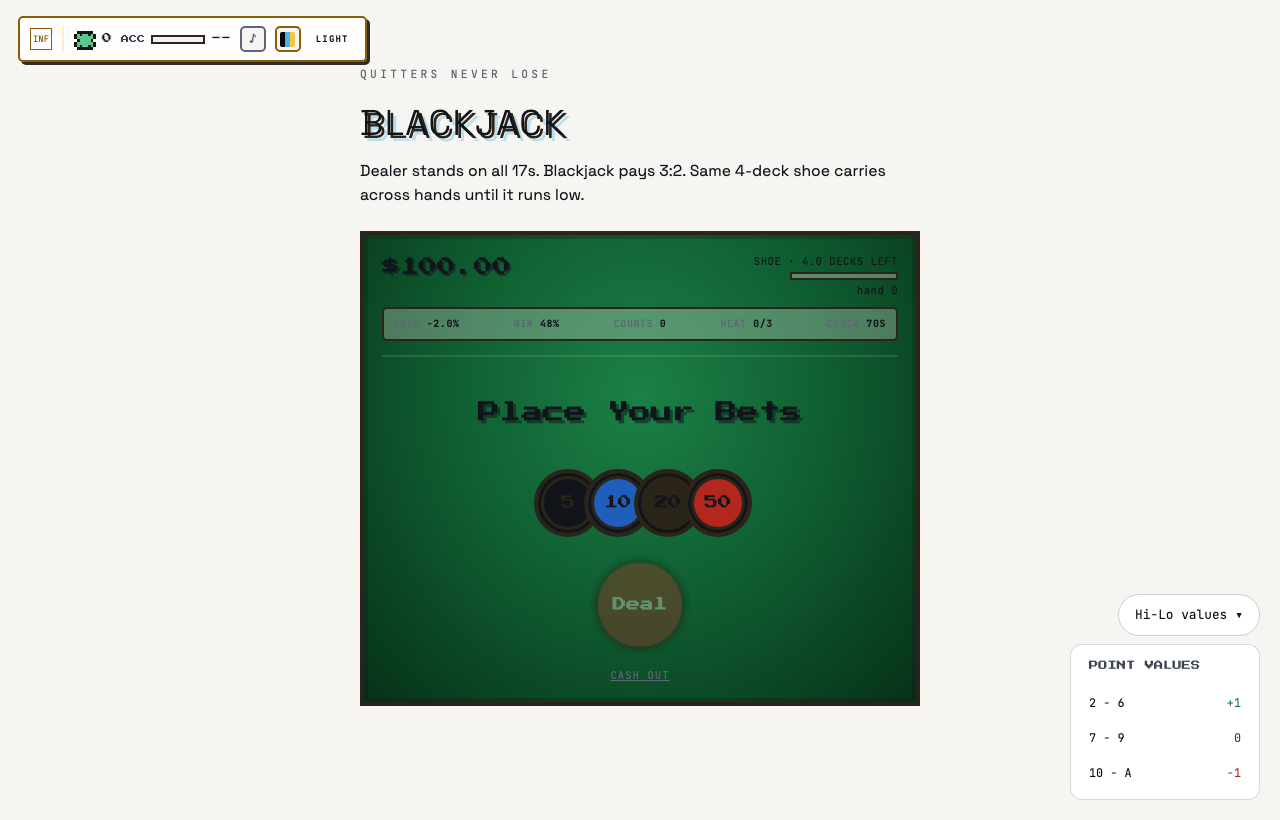
Real 4-deck blackjack with live exact bust probabilities and a Hi-Lo counting check under a pit-boss timer.
What is card counting?
Most casino games are sequences of independent trials - a roulette wheel has no memory, and the odds on the next spin are the same no matter what has already landed. Cards dealt from a shoe without replacement are different: every card that comes out changes the composition of what's left, so the true odds on the next hand shift as the shoe depletes. Card counting is the practice of tracking that shift well enough to know, at any moment, whether the remaining cards favor the player or the house.
Blackjack starts from a baseline called basic strategy: the mathematically optimal hit, stand, or double decision for every combination of your hand and the dealer's upcard, derived by working out the exact win probability of each option. Played perfectly, basic strategy alone gets the house edge down to a fraction of a percent - low, but still positive, because the dealer's fixed drawing rules give the house a small structural advantage that no single-hand decision can erase.
Counting is layered on top of that baseline. A shoe rich in tens and aces favors the player - it makes player blackjacks (which pay a bonus) more frequent and makes the dealer, who must keep drawing on stiff totals, more likely to bust. A shoe poor in high cards favors the house. By assigning each rank a small point value as it's revealed and keeping a running tally, a counter can estimate, at any point in the shoe, which side the remaining cards favor - and bet accordingly: more when the count is favorable, the table minimum when it isn't.
The resulting edge is real but small - typically well under two percent even for a skilled counter - and only shows up reliably over a large number of hands with a wide bet spread, which makes it as much a problem of managing variance as one of raw probability. Counting is arithmetic on public information, and casinos treat it as grounds to bar a player rather than as cheating. The broader lesson generalizes well past cards: a persistent statistical edge is only worth anything if you can act on it repeatedly and survive the swings around it, which is exactly the discipline that separates a real trading edge from a lucky run.
How it works
You start with a $100 bankroll and bet $5, $10, $20, or $50 per hand from a real 4-deck shoe (208 cards) that depletes across hands, only reshuffling when it runs low. Rules as implemented: dealer stands on all 17s (S17), blackjack pays 3:2, you can Hit, Stand, or Double Down (first decision only, doubling your wager for exactly one more card). There is no split and no surrender - strategy that relies on either does not apply here.
During your turn the game shows two exact numbers computed from the actual remaining shoe: the probability your next card busts you (it enumerates every card left and checks the resulting hand, so soft hands correctly read 0%) and the probability the dealer eventually busts given the visible upcard, computed by recursion over the S17 drawing rule without replacement.
On each fresh two-card hand you must answer a Hi-Lo counting check (2-6 count +1, 7-9 count 0, 10/J/Q/K/A count -1) before a pit-boss timer runs out. The timer starts at 70 seconds and tightens by 5 seconds per correct answer down to a 15-second floor. Time out or miss the count and you draw a warning - three warnings and the house bars you, ending the run.
How scoring works
Payouts are total money returned, per the code: a natural blackjack returns 2.5x your wager (a $10 bet returns $25, profit $15). A regular win or a dealer bust returns 2x ($10 returns $20). A push returns exactly your wager. A bust or dealer win returns $0. Doubling down doubles the wager at stake before settlement.
Your counting performance moves an explicit, deliberately exaggerated edge: it opens at -2% (the house's advantage over a non-counter) and shifts by exactly +2% or -2% per correct or wrong answer. The implied win chance on the next hand is 50 plus the edge, clamped between 15% and 85%, and the shoe is probabilistically reordered in whoever's favor holds the edge. Real Hi-Lo is worth about 1% - the game inflates it so you can feel it inside one session.
Use the exact bust number
For a hard 16, every card from 6 through king busts you - 8 of the 13 ranks. In an untouched 4-deck shoe that is 128 of 208 cards, about 61.5%, and the in-game readout adjusts that exactly for every card already dealt. For a hard 12 only the four 10-value ranks (10/J/Q/K) bust you - 64 of 208, about 30.8% - since an ace simply counts as 1. Soft hands read exactly 0%: the ace demotes from 11 to 1 and absorbs any card.
Compare that number to the dealer-bust readout. Standing wins only if the dealer busts, so standing on a stiff hand (12-16) is a bet that the dealer-bust probability beats your alternatives. Against a 4, 5, or 6 upcard the S17 recursion produces its highest bust numbers - that is the shoe-exact version of 'stand against a bust card'. Against a 9, 10, or ace it produces its lowest, and taking a roughly 60% bust risk on 16 can still beat standing into a hand that rarely busts.
Double down only when one card is enough
Doubling deals exactly one card and then forces the dealer's turn - you give up the right to hit again in exchange for doubling the stake. That trade is only good when a one-card hand is strong: totals of 10 or 11, where no card can bust you (bust readout 0%) and any 10-value card makes 20 or 21. Doubling a stiff total doubles your money behind a hand that busts most of the time.
The payoff math: a $10 double that wins returns $40 on $20 staked. Since a win pays 1:1, doubling raises EV exactly when your win probability on the one-card line exceeds what the flexible hit/stand line achieves - which is why it is reserved for the totals above.
Protect the count - it is worth 2% a question
Each counting answer moves your edge by exactly 2 percentage points, symmetric in both directions, starting from -2%. Two correct answers put you at +2%; two misses put you at -6%. The Hi-Lo tally is trivial per card (2-6 are +1, 7-9 are 0, tens and aces are -1) - the difficulty is purely the tightening clock, which drops from 70 seconds toward the 15-second floor precisely because you keep being right.
Warnings are tracked separately from the edge, and three of them end the run no matter how large your bankroll is. When the timer is nearly out, submitting a fast attempt beats letting it expire - both a miss and a timeout cost a warning, but only an unanswered check forfeits the chance at the +2%.
A worked example
Setup: you bet $10 and are dealt a hard 16 (10-6); the dealer shows a 9.
Bust check on 16: 8 of the 13 ranks (6 through king) bust you. In a fresh 4-deck shoe that is 8 ranks x 16 copies out of 208 cards.
Dealer-bust check: under S17 a 9 upcard reaches 17 or more without busting most of the time, so the live recursion reports one of its lowest dealer-bust numbers - standing here wins only in that minority of cases.
You hit and draw a 4, making a hard 20 - now only an ace can bust you, so you stand.
The dealer must hit a 16 under S17 and draws a 10, busting at 26. A dealer bust pays 2x the wager.
Counting side: tally the Hi-Lo value of every card seen (2-6 is +1, 7-9 is 0, ten-value and ace is -1).
One correct counting answer moves the edge by exactly 2 percentage points for the next deal.
Common mistakes
• Treating a soft total like a hard one. A,6 can never bust on one card - the game literally displays 0% - so standing on soft 17 surrenders free improvement.
• Doubling on stiff totals. Doubling 12-16 doubles the stake behind a hand that busts the majority of the time; the play exists for 10 and 11.
• Standing on 16 against a 9, 10, or ace because 61% bust risk feels scary. Compare it to the dealer-bust readout - standing into a strong upcard loses more often than the hit does.
• Letting the heat timer expire instead of answering. A timeout costs a warning AND forfeits the possible +2% edge; a fast attempt risks only the same warning.
• Playing basic-strategy lines that do not exist here. There is no split and no surrender in this implementation - pairs are just their hard total.
Why interviews test this
Blackjack is the canonical conditional-probability-without-replacement setting, which is exactly why it shows up in quant interviews: every card seen changes the distribution of every card to come. The bust readout here is the live version of the interview question 'what is the probability the next card busts you, given what you have seen?' - an enumeration over a finite, depleting population.
Card counting is also the cleanest toy model of edge detection: a tiny persistent statistical edge (about 1% in real Hi-Lo), harvested by bet timing under constraints. Interviewers use it to test whether a candidate separates the size of an edge from the variance around it - and whether they notice that most hands, like most trades, are close to fair either way.
Play Blackjack on Outcry
Blackjack is free to play on Outcry, in the Quitters Never Lose section, and every run is timed and scored. Read the guide once, then play Blackjack and check your score against the strategy above. The guide book has a written guide for every other game, and the practice hub and mock assessments put the same skills under a real screen's clock.