Brain Teasers · Brain Teasers Lab
Brain Teasers Lab - Playable Interview Puzzles
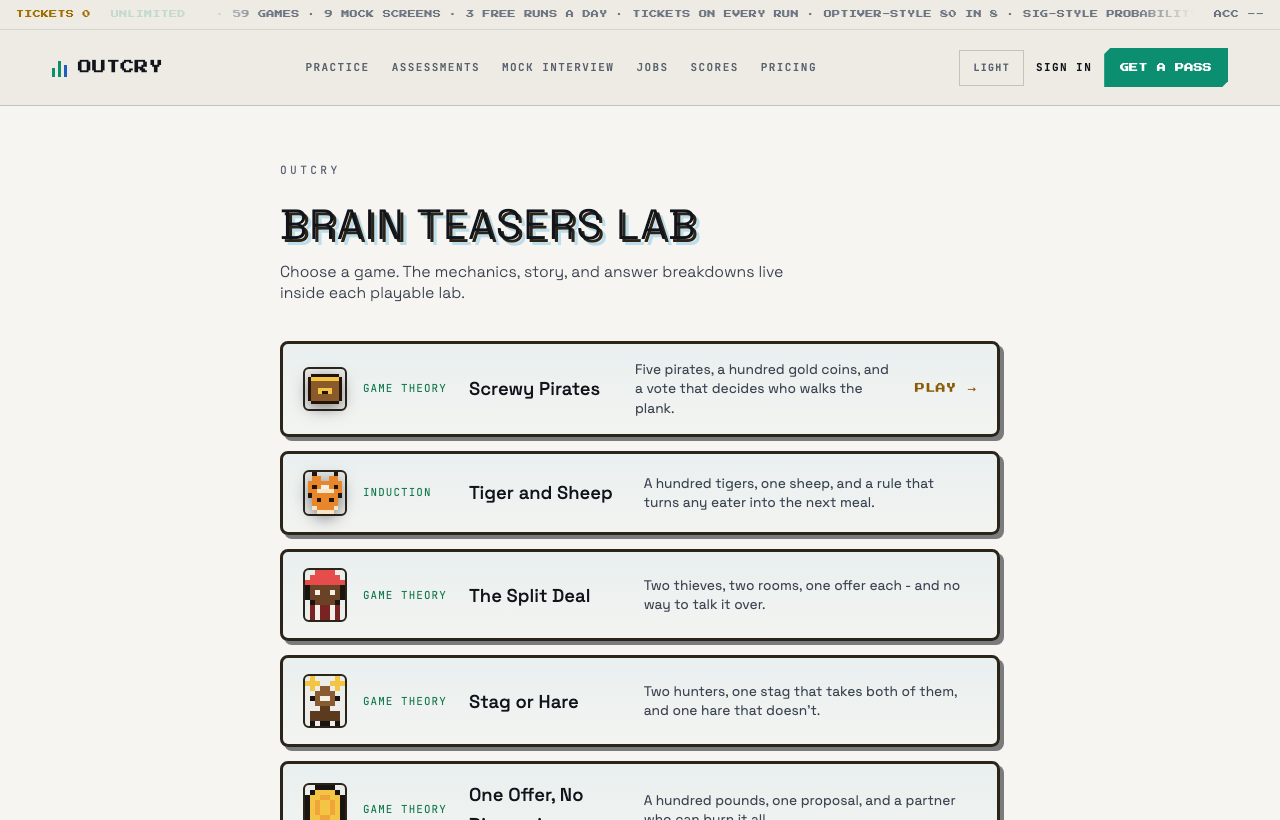
A shelf of classic logic and game-theory puzzles, each played as an animated story that makes you commit to an answer before revealing the reasoning.
What is a brain teaser?
A brain teaser, in the sense used across quant finance, trading, and consulting interviews, is a short logic, probability, or game-theory puzzle used to test how a candidate reasons under uncertainty. The format goes back to recreational mathematics - puzzle columns by figures like Sam Loyd and Martin Gardner - but its interview use took off once trading desks and consulting firms started asking candidates puzzles instead of, or alongside, technical questions, on the theory that structured thinking under time pressure is hard to fake and a decent proxy for the kind of reasoning the job requires.
What makes a good brain teaser is that it dresses up a small, well-understood formal idea in an unfamiliar story. Doors and goats become a lesson in conditional probability; pirates voting on gold become a lesson in backward induction; a line of hats becomes a lesson in encoding information in a single shared signal. The story is a costume, and the same costume can hide a probability idea one week and a game-theory idea the next - which is why the tags matter: they tell you which branch of mathematics a story is testing before you commit to an approach.
Because the underlying ideas are few and recur constantly - conditional probability, dominant strategies and equilibria, mathematical induction, invariants in a search - solving one teaser well transfers directly to the next one that uses the same idea in a different costume. That is the skill being tested: recognising which of a handful of tools a new story is asking for, and being able to state the assumptions that tool depends on out loud.
The corollary is that brain teasers punish two opposite failures equally: freezing because the story is unfamiliar, and pattern-matching to a memorised answer without checking that this story's assumptions match. A convincing answer names its assumptions, works from a base case or a clean dominance argument, and shows the reasoning chain - which is the discipline this lab is built to practice.
How it works
The Brain Teasers lab is an index of playable puzzles. Two featured games - Screwy Pirates and Tiger and Sheep - have their own custom experiences with graded answer builders. The other ten run in a shared story engine: pixel-art characters act out the setup beat by beat, the assumptions appear one at a time, and then the game stops on a single question.
At the question screen you type your answer into a free-text box before anything is revealed. Locking in a guess is not graded - the game shows you what you wrote next to the real answer. The answer then unfolds as a sequence of labelled steps you click through, followed by a 'Why it works' breakdown covering the underlying principle and where it shows up in the real world.
Every story teaser also has a server-rendered written solution at /brain-teasers/<slug>/solution, cross-linked from the playable page. The numbers in the written version match the game's telling exactly.
How scoring works
The story teasers have no score. Your typed guess is displayed back to you unchanged when the answer appears - there is no grader, no points, and no tiers. The two featured games each have their own answer builder with deterministic checks, described in their own guide entries.
Access works differently here than in other labs: the eleven story-format teasers share a single lifetime unlock for free users. Opening any one of them uses the whole group's allowance, so pick the teaser you most want to see solved. Screwy Pirates is linked directly from the lab page without that gate.
Commit before you reveal
The entire training value of this lab is the gap between your locked-in guess and the real answer. If you skip the guess, you get a nicely animated explanation and learn almost nothing about your own instincts. Write down a specific answer - a number, a named strategy, a yes or no.
When your guess is wrong, the answer steps are structured so you can find the exact step where your reasoning diverged. That step is the thing to remember.
Read the assumptions as constraints
Each teaser states its assumptions explicitly before the question - rationality, no communication, common knowledge, and so on. Nearly every teaser's answer flips if one assumption changes, and the breakdown sections routinely point at which one. In an interview, restating the assumptions before answering is what buys you time and credibility.
The tags on the lab page (Game theory, Probability, Induction, Case reduction, Conditional probability) tell you which tool to reach for before the story starts.
A worked example
Open The Third Door. The story plays out the Monty Hall setup: three doors, one car, a host who knows where the car is. The assumptions appear: the host always opens a non-chosen door, always reveals a goat, always offers the switch. The question asks whether you switch and what your odds are.
Type '50/50, no point switching' - the most common wrong answer - and lock it in. The answer headline says switching wins two-thirds of the time. Stepping through, the divergence point is Step 1: your first pick was 1/3 from the start, and nothing the host does changes that. That single step is the lesson the whole game exists to deliver.
Common mistakes
• Skipping the guess box and going straight to the answer - you lose the only feedback signal the game offers.
• Burning the free-tier group unlock on a teaser you already know cold, when the whole group locks after one reveal.
• Watching the answer steps without clicking through them one at a time - the pacing exists so each inference lands before the next one builds on it.
• Ignoring the 'Why it works' breakdown, which is where the transferable interview material lives.
Why interviews test this
These are the puzzles interviewers ask, in close to their canonical forms: Monty Hall, the birthday problem, hat parity, bridge crossing, the prisoner's dilemma family. The lab's format - assumptions first, commitment second, reasoning last - is also the format of a good interview answer.
Play Brain Teasers Lab on Outcry
Brain Teasers Lab is free to play on Outcry, in the Brain Teasers section, and every run is timed and scored. Read the guide once, then play Brain Teasers Lab and check your score against the strategy above. The guide book has a written guide for every other game, and the practice hub and mock assessments put the same skills under a real screen's clock.