Drill Lab · Arithmetic Drill
Arithmetic Drill Strategy - Mental Math Race
A 20-card flashcard race across twelve arithmetic categories - play solo or race a ghost recording of a real past run.
What is mental math fluency?
Mental math fluency is the ability to carry out arithmetic accurately in your head, without paper, a calculator, or scratch work, and to do it fast. It is not the same thing as mathematical ability in the broader sense - understanding why an algorithm works and being able to execute one quickly under pressure are separate skills, and a person can be strong in one without the other.
It is a trainable skill because it depends on technique. The algorithms taught in school for pencil-and-paper work - right-to-left addition with carries, long division, borrowing in subtraction - are optimized for a written record. Fluency comes from a different toolkit: computing left to right so the important digits are known first, using complements and rounding instead of borrowing, and anchoring multiplication on round numbers and adjusting. These are learnable procedures, and like any procedural skill they improve with repetition.
Fluency and accuracy trade off against each other, and the aim is holding both at once. A technique that is fast but error-prone under time pressure has not been learned yet; the goal is a method that stays reliable at speed, which is why timed, scored practice is what builds it.
Quant and trading interviews test mental arithmetic because so much of the work is many small computations done quickly and correctly, one after another, while attention is needed elsewhere for the decision that matters. A candidate who has to think hard about 47 x 62 has no spare working memory left for pricing, risk or probability reasoning happening at the same time. Speed drills like this one, and the equivalents used in market-making recruitment, filter for arithmetic that has become automatic.
How it works
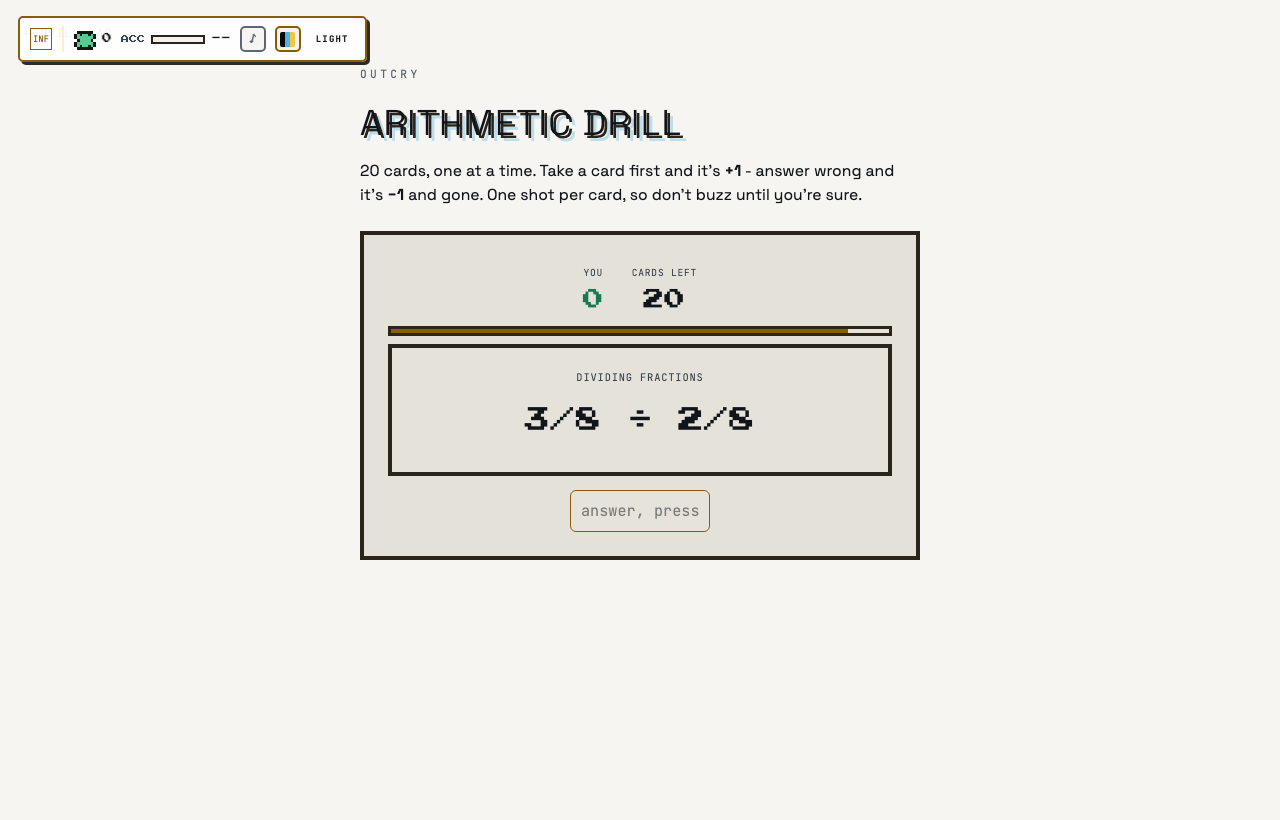
The drill deals a fixed deck of 20 cards, one at a time. Every card is a freshly generated problem from one of twelve categories: long addition (three-digit plus three-digit), long subtraction, two-digit by two-digit multiplication, fast division (always exact), decimal addition, subtraction, and multiplication, and five fraction operations - add, subtract, multiply, divide, and reduce to lowest terms. Type your answer and press enter; there is no second attempt on a card.
You can play solo or race a ghost - a recording of a real past run on the exact same deck. The deck is rebuilt from a shared seed, so the ghost sees the same cards in the same order and claims each card at the moment its player actually answered it. If the ghost buzzed in wrong on a card, it eats the penalty and the card stays live for you.
Each card has a 10 second timeout so one stumper cannot stall the race. A card nobody claims simply expires. Fraction answers accept either "a/b" or a decimal, but reduce-fraction cards require the exact reduced form - 4/8 does not pass for 1/2. Decimal answers are graded with a small numeric tolerance, whole-number answers by exact match.
How scoring works
You score +1 for taking a card with a correct answer and -1 for buzzing in wrong. A wrong answer forfeits the card immediately, the same as being beaten to it. A timed-out card scores nothing for anyone.
In ghost mode the ghost scores +1 for each card it claims first with a correct answer and -1 where its recorded run answered wrong. The race ends when the 20th card resolves; there is no wall clock, so a fast run simply finishes fast.
Your run is saved with its seed and per-card times, which is what lets a future player race you as a ghost on the identical deck.
Work left to right
School arithmetic teaches right-to-left with carries, which is the slowest possible order under a clock because you cannot say any digit until you have finished all of them. For a card like 738 + 486, go left to right: 700 + 400 = 1100, then 38 + 86 = 124, giving 1224. You hold one running total instead of three carry flags, and the leading digits - the ones that catch a typo - come first.
For subtraction, use complements instead of borrowing. 903 - 458 is easier as 903 - 458 = 903 - 500 + 42 = 445. Round the subtrahend to a clean number, subtract, then add the difference back. Borrowing across a zero is where slow, error-prone runs die; complements never borrow.
For two-digit multiplication, anchor on a round number: 47 x 62 = 47 x 60 + 47 x 2 = 2820 + 94 = 2914. When one factor is near a landmark, use the difference instead: 49 x 38 = 50 x 38 - 38 = 1900 - 38 = 1862. One adjustment step beats a full long-multiplication grid every time.
Make the fraction cards automatic
The denominators here are always drawn from a small set (2, 3, 4, 5, 6, 8, 9, 10, 12), so the useful common denominators are a short list you can memorize: pairs from this set almost always meet at 12, 24, or the product. For addition and subtraction, cross-multiply mechanically - a/b + c/d = (ad + bc)/bd - then reduce. Do not hunt for the least common denominator under a clock; the cross-multiplied form plus one reduction is faster than being clever.
Multiplication and division should be cancel-first. For 3/8 x 4/9, cancel the 4 into the 8 and the 3 into the 9 before multiplying: 1/2 x 1/3 = 1/6. Division is one flip away: a/b divided by c/d is a/b x d/c, then cancel. If you multiply first and reduce later you are doing gcd work on bigger numbers for no reason.
Reduce-fraction cards are pure gcd recognition, and the generator builds them by scaling a reduced fraction by 2 through 6. So check the small divisors in order - both even? Halve. Digit sums divisible by 3? Divide by 3. Then 5. Two passes of that reaches lowest terms on every card this game can deal. Remember the grader here demands the exact reduced fraction, so finish the reduction.
Race the ghost
In ghost mode the winning move changes: you are claiming cards before a specific opponent whose speed on each card is fixed. A ghost that averaged 6 seconds a card can be beaten by someone slower overall who is fast on the easy categories - the addition and division cards resolve in 2 to 3 seconds for a practiced player, and every one you take is a point the ghost cannot have.
The -1 for a wrong buzz makes guessing negative expected value. A wrong answer both costs you a point and hands the card's point opportunity away, a two-point swing against sitting on your hands. If a card is not coming to you inside a few seconds, it is usually better to let a strong ghost take it and be ready for the next flip than to fire a guess.
Solo runs are where you build the deck sense: after each run, note which of the twelve categories cost you the most time. Most players lose the race on exactly two categories - usually two-digit multiplication and fraction addition - and targeted practice on those moves the whole run more than grinding the categories you already own.
A worked example
The card: 67 x 84. Anchor on a round number by splitting 84 into 80 + 4.
First piece - multiply by 8, then shift for the extra zero.
Second piece.
Add left to right for the final answer.
One-beat sanity check before submitting: round both factors and confirm the magnitude.
Common mistakes
• Buzzing in with a guess when unsure - a wrong answer scores -1 and forfeits the card, so a guess is a two-point swing worse than passing.
• Doing multiplication right to left with carries instead of anchoring on a round number and adjusting.
• Submitting an unreduced fraction on a reduce-fraction card - the grader requires the exact lowest-terms form, so 4/8 fails where 1/2 passes.
• Hunting for least common denominators on fraction addition instead of cross-multiplying and reducing once.
• Forgetting the 10 second per-card timeout and settling into a long calculation the card will not wait for.
Why interviews test this
Timed arithmetic under pressure is the front door of trading interviews. Zetamac-style speed tests and firm-specific equivalents at market-making firms filter on exactly this skill: many small computations, fast, with a penalty for errors. Traders do not do long division all day; fluent arithmetic frees working memory for the decision.
The race format here mirrors the culture: in a trading interview, an answer that is fast and right beats one that is slow and right, and one that is fast and wrong is worse than silence. That is precisely the +1 / -1 / pass structure of this drill.
Play Arithmetic Drill on Outcry
Arithmetic Drill is free to play on Outcry, in the Drill Lab section, and every run is timed and scored. Read the guide once, then play Arithmetic Drill and check your score against the strategy above. The guide book has a written guide for every other game, and the practice hub and mock assessments put the same skills under a real screen's clock.