Economic Consulting · The Antitrust Simulator
Antitrust Simulator Guide - HHI and Mergers
Define the relevant market for a merger, compute the HHI delta, and file the verdict the guidelines support.
What is antitrust / market power?
Antitrust, or competition law, exists to stop firms from accumulating or abusing market power to the point that they can raise prices, cut quality, or slow innovation beyond what a competitive market would allow. Size alone is not the concern. The worry is that a firm insulated from competitive pressure can extract more from customers than it could if rivals were free to undercut it, and that the loss to consumers and the economy from that outcome is real and measurable.
Market power is the ability to profitably raise price above the competitive level without losing so many customers to rivals that the price increase backfires. It tends to rise with market concentration - how much of the market's sales sit with a small number of firms - and with barriers that keep new competitors from entering to erode that concentration. A market with many roughly equal competitors and easy entry gives any single firm little room to raise prices; a market with one or two dominant firms and high barriers to entry gives them much more.
The standard tool for measuring concentration is the Herfindahl-Hirschman Index, the sum of each firm's market share squared. Squaring is what makes it sensitive to dominance as well as headcount - a market split between one giant and a handful of small players scores far higher than one split evenly among many similarly sized firms, because the giant's large share contributes disproportionately once squared.
Before any of that arithmetic can happen, someone has to decide what counts as 'the market' in the first place - which competing products constrain a firm's pricing and which do not. This market-definition question is contested precisely because it is decisive: draw the boundary widely enough to include distant substitutes, and concentration looks low; draw it narrowly around only the closest competitors, and the same firms look dominant. Economists resolve this with substitutability evidence - would enough customers switch to a candidate substitute if the price of the core product rose modestly.
Antitrust enforcement, most visibly through merger review, shapes prices, product variety, and innovation incentives across the whole economy, which is why market definition and concentration measurement are the load-bearing steps in real competition-policy decisions.
How it works
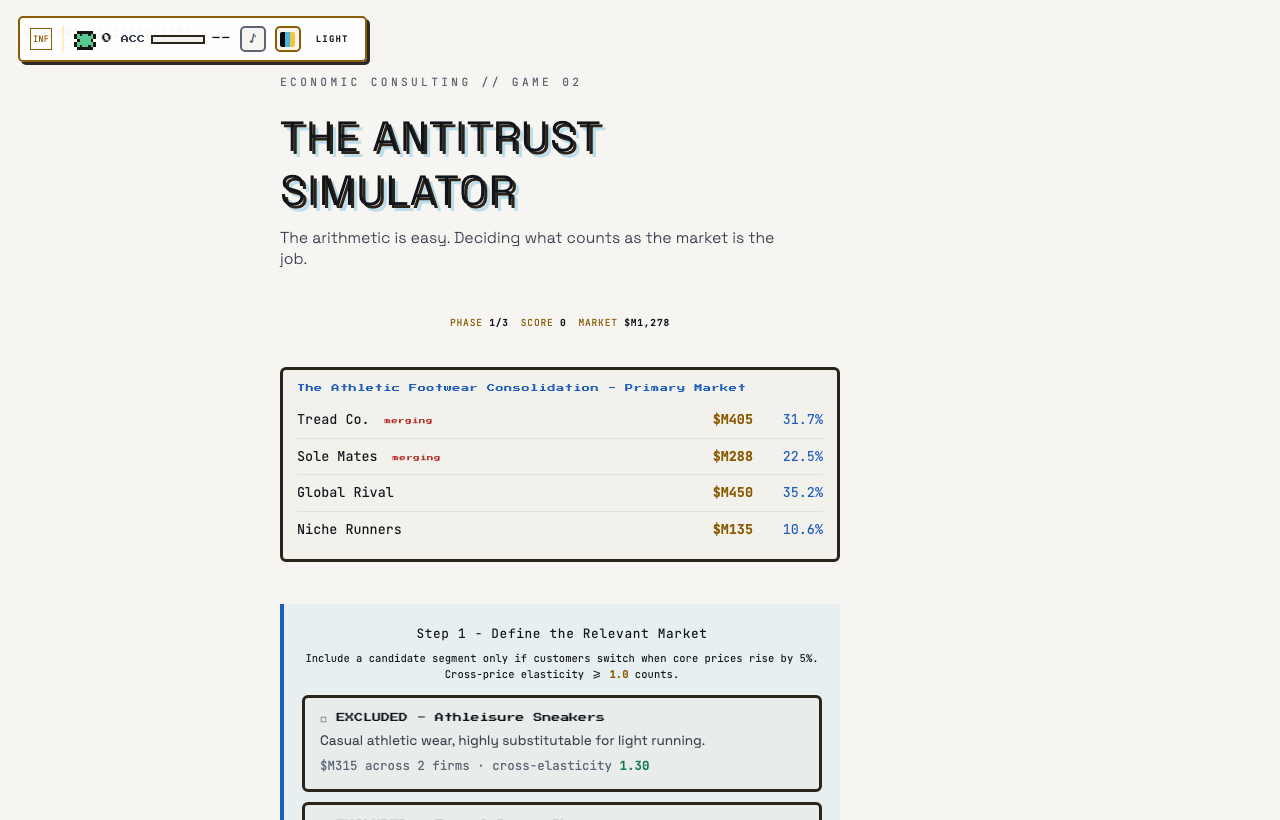
A merger case lands on your desk - drawn at random from a pool that includes four real landmark cases (Kroger/Albertsons, Epic v. Apple, AB InBev/Modelo, Ohio v. Amex) and 35 generated industry variations. Each case shows a core market of named firms with revenues, two of them flagged as merging, plus a list of candidate segments you may add to the market. Each candidate lists its firms' revenues and a cross-price elasticity with the core product.
Phase 1 is market definition: toggle each candidate segment in or out. A segment belongs when its cross-price elasticity is at or above the case's substitute threshold (1.0 in every case) - customers who switch when core prices rise 5% are in the market. A live readout shows the market total, current HHI, and the delta HHI the merger would cause under your definition.
Phase 2 asks for the concentration increase, delta HHI, computed on the correctly defined market using the two merging firms' shares. Phase 3 shows the 2010 US Horizontal Merger Guidelines bands and asks you to file one of three verdicts: cleared, full investigation, or presumed anticompetitive. Each answer locks after one check; finishing loads a new random case.
How scoring works
Phase 1: +1 point for every candidate segment you classify correctly (in or out), scored per segment, so partial credit exists.
Phase 2: +3 points if your delta HHI is within the case's tolerance (25 to 40 points depending on the case) of the true value computed on the correctly defined market - not on whatever market you drew in phase 1.
Phase 3: +2 points for the correct verdict. The verdict logic follows the code exactly: delta below 100 is cleared regardless of concentration; post-merger HHI above 2500 with delta above 200 is presumed anticompetitive; an unconcentrated market (HHI below 1500) is cleared; everything else gets full scrutiny. Checks record skill attempts under game-theory, combinatorics, and logic-puzzles respectively.
Market definition is the whole case
The same merger clears or fails depending on where you draw the boundary, which is why the merging parties always argue for a wide market (more rivals, smaller shares, lower HHI) and the agency argues for a narrow one. The game gives you an objective test: cross-price elasticity at or above 1.0 means customers defect to that segment when core prices rise, so it constrains pricing and belongs in the market.
Read the elasticity number before the story. Every case dresses its candidates in plausible narratives - club stores sell groceries, consoles run games - but the displayed elasticity is the ground truth. A segment at 0.45 does not belong no matter how adjacent it sounds; one at 1.25 belongs even if it surprises you.
Economically, the elasticity encodes the SSNIP test: would a small but significant non-transitory increase in price (the standard 5%) push enough customers to this substitute to make the increase unprofitable? Low elasticity means the trip mission, occasion, or lock-in differs enough that it does not.
HHI arithmetic worth knowing cold
HHI is the sum of squared market shares in percentage points, so a monopolist scores 100^2 = 10,000 and a market of five equal firms scores 5 x 20^2 = 2,000. Squaring is what makes it a concentration measure: a 40% firm contributes 1,600 while four 10% firms together contribute 400.
The merger delta has a closed form: delta HHI = 2 x s1 x s2, where s1 and s2 are the merging firms' shares. It comes from (s1 + s2)^2 - s1^2 - s2^2 = 2 s1 s2, and every other firm's share is untouched. That means the delta depends only on the two merging parties - never on how the rest of the market is split - and you never need to recompute the whole index.
Practical flow for phase 2: total the correctly defined market's revenue, take the two merging revenues as percentages of it, multiply them, double it. The game even prints the two shares for you in the phase 2 prompt, so the only work left is 2 x s1 x s2.
The guidelines thresholds as a decision tree
The 2010 Horizontal Merger Guidelines bands are: HHI below 1500 unconcentrated, 1500 to 2500 moderately concentrated, above 2500 highly concentrated. Screen in this order: first check the delta - below 100 points the merger is unlikely to harm competition regardless of concentration. Then band the post-merger HHI.
Highly concentrated post-merger HHI with a delta above 200 is presumed to enhance market power - that verdict shifts the burden of proof to the merging parties, which is why it is the strongest outcome. An unconcentrated post-merger market is cleared. Everything in between - moderate concentration with a meaningful delta, or high concentration with a delta between 100 and 200 - draws full scrutiny.
Note the order matters: a delta of 80 in a 4,000-point market still clears under this screen, because a tiny share overlap cannot be what creates the market power.
A worked example
Take the Kroger/Albertsons case. Core market: Kroger $148B, Albertsons $78B (both merging), regional grocers $110B. Candidates: supercenters ($160B + $50B, cross-elasticity 1.25), wholesale clubs (0.45), dollar stores (0.35). Threshold is 1.0, so only supercenters belong - diversion data shows customers defect to Walmart on price hikes, while club stores serve stock-up trips and dollar stores lack full-basket breadth.
The correctly defined market totals 148 + 78 + 110 + 160 + 50 = $546B. Kroger's share is 148/546 = 27.11%; Albertsons' is 78/546 = 14.29%.
Delta HHI = 2 x 27.11 x 14.29 = about 775 points. No need to compute the full index for this step.
For the verdict, band the post-merger HHI: the pre-merger index is roughly 2,290 (squares of 27.11, 14.29, 20.15, 29.30, 9.16), so post-merger it is about 3,060 - highly concentrated - with a delta far above 200. Verdict: presumed to enhance market power, challenge it. That matches the screen: delta over 100, band highly concentrated, delta over 200.
Common mistakes
• Defining the market by vibes instead of the printed elasticity. The threshold is 1.0 in every case; a candidate at 0.9 is out and one at 1.05 is in, whatever the flavor text suggests.
• Computing delta HHI on your own (possibly wrong) market. Phase 2 checks against the ground-truth market. Use the two shares the game prints in the phase 2 prompt.
• Recomputing the entire HHI twice to get the delta. 2 x s1 x s2 is exact and takes one line; the long way invites rounding drift outside the 25 to 40 point tolerance.
• Using revenue instead of share in the delta formula. The formula wants shares in percentage points, so a 27.11% share enters as 27.11.
• Skipping the delta-below-100 check. A merger with a tiny overlap clears even in a highly concentrated market; jumping straight to the concentration band gets the verdict wrong.
Why interviews test this
Economic consulting interviews - especially at firms doing merger work like Compass Lexecon, Cornerstone, NERA, or Bates White - routinely open with market definition, because it is the step that dictates every number after it. Expect to be pushed on the SSNIP logic: why the merging parties want a broad market, why the agency wants a narrow one, and what evidence (diversion ratios, cross-elasticities, switching data) settles it.
The HHI mechanics show up as case math: given shares, compute the index, the delta, and apply the guidelines thresholds. Knowing delta HHI = 2 x s1 x s2 by heart, and the 1500 / 2500 / delta 100 / delta 200 screen, turns a five-minute computation into thirty seconds and signals familiarity with how merger review works.
Play The Antitrust Simulator on Outcry
The Antitrust Simulator is free to play on Outcry, in the Economic Consulting section, and every run is timed and scored. Read the guide once, then play The Antitrust Simulator and check your score against the strategy above. The guide book has a written guide for every other game, and the practice hub and mock assessments put the same skills under a real screen's clock.